| 1. |
महिदास ऐतरेय - Mahidāsa Aitareya
the author of the Aitareya Upaniṣad (ऐतरेय उपनिषद्). |
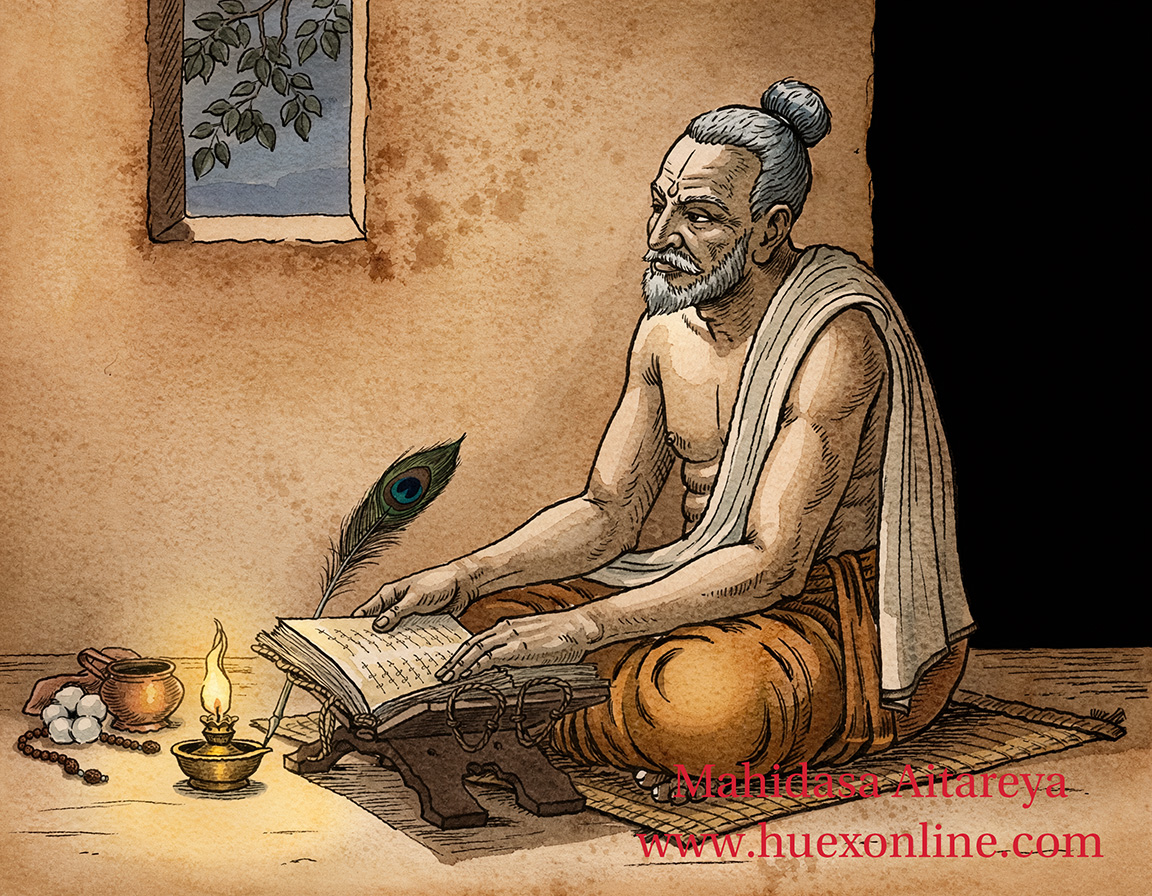
This picture was developed on June 16, 2026.
|
The sage Mahidāsa Aitareya named the scripture in honor of his mother, Itara, and received the name Mahidāsa ("Servant of the Earth") after being blessed with divine wisdom by the earth goddess Bhumi. |
| 2. |
क्वा - Raikva
appeared in छान्दोग्योपनिषद् - Chāndogya Upaniṣad
|
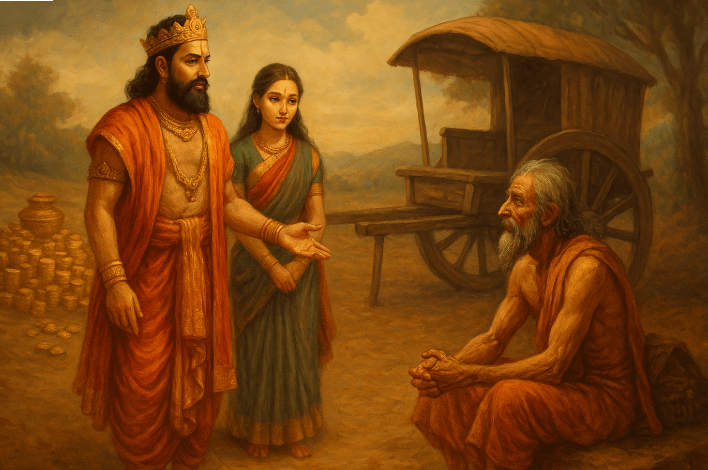
King Janashruti and the sage Raikva, who pulled the cart, source: arunsingha.in, access date: June 16, 2029.
|
The sage Raikva, a philosopher of the Chariots, has his teachings recorded in the Chāndogya Upaniṣad, Chapter 4. These teachings illustrate the importance of giving alms not for fame, but out of goodness and compassion. Raikva said to King Janashruti:
“In all things, there are many elements that are worshiped as gods; there is the wind that carries everything; there is the fire that consumes everything it touches; there is the breath of life that powers living things. But all these are driven by the inner spirit. This spirit was not created by anyone; it exists by itself, and yet it creates and sustains all things. Thus, all things are complex instruments working at the command of the spirit.”
He continued, “O king! Do not be arrogant or conceited in your giving. Go to your palace, great king, and give, but not with arrogance; give generously, but not selfishly; give willingly, but not for fame; give not as your own, but as something given by the spirit to be given to others.” Whoever sees this truth will become insightful, and for him nothing will be lacking, and he will enjoy all things.” |
| 3. |
शाण्डिल्य - Śāṇḍilya
(बृहदारण्यक उपनिषद् - Bṛhad-āraṇyaka Upaniṣad)
(छान्दोग्योपनिषद् - Chāndogya Upaniṣad)
(शाण्डिल्यविद्या-Śāṇḍilyavidyā)
|
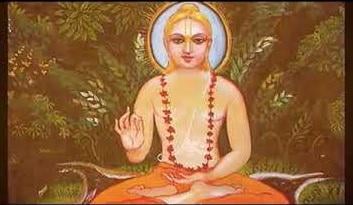
Source: www.reddit.com, access date: Jun.17, 2029
|
Maharishi Śāṇḍilya, meaning "associated with the full moon," thus signifying his association with the moon god, was renowned for his profound understanding of the nature of deities and the self. He authored the Śāṇḍilya Upanishads, including the Shatpatha Brahmana, the Chandogya Upanishad, the Brihadaranyaka Upanishad, and the Bhagavata Purana. His most important work is a foundational treatise on Bhakti, systematically outlining the doctrines of faith. His teachings extended to Yoga and Tantra. As seen in the Śāṇḍilya Upanishad (one of the 20 Yoga Upanishads attached to the Arhatraveda), this text is structured as a dialogue in which Śāṇḍilya questions his teacher, Adhidanva Saunaka, and explores advanced yogic practices such as pranayama, asanas, mudras, and the attainment of states such as Yoga Nidra (a consciousness beyond waking, dreaming, and sleeping). The philosophy emphasizes inner and outer purity (Saucha) through Atma Vidya (knowledge of oneself), leading to the attainment of infinite oneness with God. He composed a hymn praising Brahma, beginning with the declaration – “Sarvam khalvidam brahma” (“Indeed, these are Brahman”). The significance and relevance in modern times: The contributions of the great sage Śāṇḍilya, particularly Śāṇḍilya Vidya, are significant. It makes profound philosophy more accessible through devotion rather than mere renunciation of worldly things. In a world full of distractions, this doctrine offers a timeless antidote: quiet contemplation of God's presence fosters inner peace and ethical living. This teaching influenced later Bhakti traditions, including the teachings of Ramanujacharya and the Bhagavata school, and continues to be reflected in yoga and mindfulness practices today. For those interested in further study, the translation of the Shandogya Upanishad, or Śāṇḍilya Bhakti Sutra, serves as a starting point to remind us that, as the great sage Śāṇḍilya stated, God is not far away, but is the very breath of our existence. More details can be found at https://www.reddit.com/r/IndicKnowledgeSystems/comments/1nqdah8/sandilya_the_sage_and_his_legacy/. |
| 4. |
Satyakāma Jābāla (सत्यकाम जाबाल)
(छान्दोग्योपनिषद् - Chāndogya Upaniṣad)
|

Source: arunsingha.in, access date: Jun.18, 2026.
|
|
| 5. |
Jaivali
(बृहदारण्यक उपनिषद् - Bṛhad-āraṇyaka Upaniṣad)
(छान्दोग्योपनिषद् - Chāndogya Upaniṣad)
(शाण्डिल्यविद्या-Śāṇḍilyavidyā)
|
|
Like King Ajatashatru of Kashi and King Asvapati Kaikeya of Madra, he is depicted as a major Hindu philosopher-king. He was the contemporary of King Janaka of Videha, and is among the most famous kings of Uttara Pañchāla-rattha who ruled from Kampila-nagara, the others being Kraivya, Keśin Dālbhya, Śona Sātrāsāha, and Durmukha.
He teaches Svetaketu, son of Uddalaka Aruni who was a disciple of Dhaumya Ayoda (Mahabharata I.iii.20), his celebrated Panchagni Vidya i.e. the "Doctrine of the Five Fires" that explains the process of rebirth, which is an upasana. |
| 6. |
उद्दालक - Uddālaka or อุททาลกะ อารุณิ (उद्दालक आरुणि - Uddālaka Āruṇi)
|
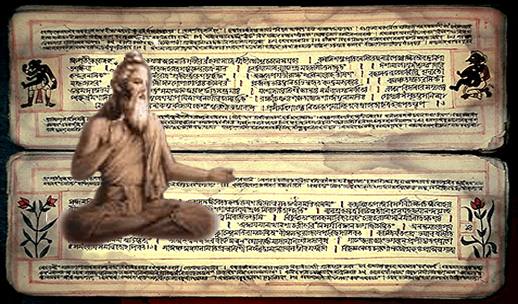
Source: https://sreenivasaraos.com, access date: Jun.25, 2026.
|
He lived around 800 BC. He was a highly respected Vedic sage, mentioned in the Bṛhad-āraṇyaka Upaniṣad and Chāndogya Upaniṣad. One of his disciples was the sage Yanyavalkya. One Israeli scholar (Ben-Ami Scharfstein) considers him the first sage to be hailed as a 'natural scientist' in the intellectual history of the world. In the Chāndogya Upaniṣad, he poses metaphysical questions about the nature of reality and truth, observing constant change and asking if anything is eternal and unchanging. From these questions, embedded in a dialogue with his son, he introduces the concepts of Ātman (spirit, self) and Brahman (universal self). |
| 7. |
Śvetaketu (श्वेतकेतु)
(छान्दोग्योपनिषद् - Chāndogya Upaniṣad)
|
Source: yoga.pro.br, access date: Jul.14, 2026
|
He was an important sage, the son of the sage Uddālaka Āruṇi. He received the great sermon "Tat tvam Asi" (तत् त्वम् असि), or "You are that," a core teaching conveying the oneness between Atman (individual soul) and Brahman (Ref. the ultimate reality of the universe).
History and Important Role
- Education and Pride: At the age of 12, Shvetaketu was sent by his father to study the Vedas at a teacher's school. He returned at the age of 24, fully knowledgeable but full of self-pride. His father posed a question to melt his arrogance: "Have you studied what makes the unheard heard, what we do not think thought, or what we do not know known?" (Reference: Śvetaketu).
- Lessons on the Supreme Truth: His father (Uddālaka) taught Śvetaketu through various analogies concerning Brahman and Atman, such as having him cut open a fig seed to find its essence, or dissolving salt in water, to show that "Brahman" (the ultimate reality of the universe) and "Atman" (the universal spirit) are hidden in everything but invisible to the naked eye. (Reference: The Discovery of the Self: “Tat Tvam Asi” and the Journey Inward)
- Reformer of Social Rules: Beyond the Upanishads, the Mahabharata epic states that Śvetaketu established the rule that men and women should have only one spouse. (Monogamy system) After he saw his mother being taken away by another Brahmin in front of his father, according to ancient custom which did not yet have a strict prohibition. (Reference: Śvetaketu - Hindupedia, the Hindu Encyclopedia) |
| 8. |
Bhāradvāja (भरद्वाज) |
|
|
| 9. |
Gārgyāyana |
|
|
| 10. |
Pratardana |
|
|
| 11. |
Bālāki |
|
|
| 12. |
Ajātaśatru |
|
|
| 13. |
Varuṇa |
|
|
| 14. |
Yājñavalkya |
|
|
| 15. |
Gārgī |
|
|
| 16. |
Maitreyī |
|
|