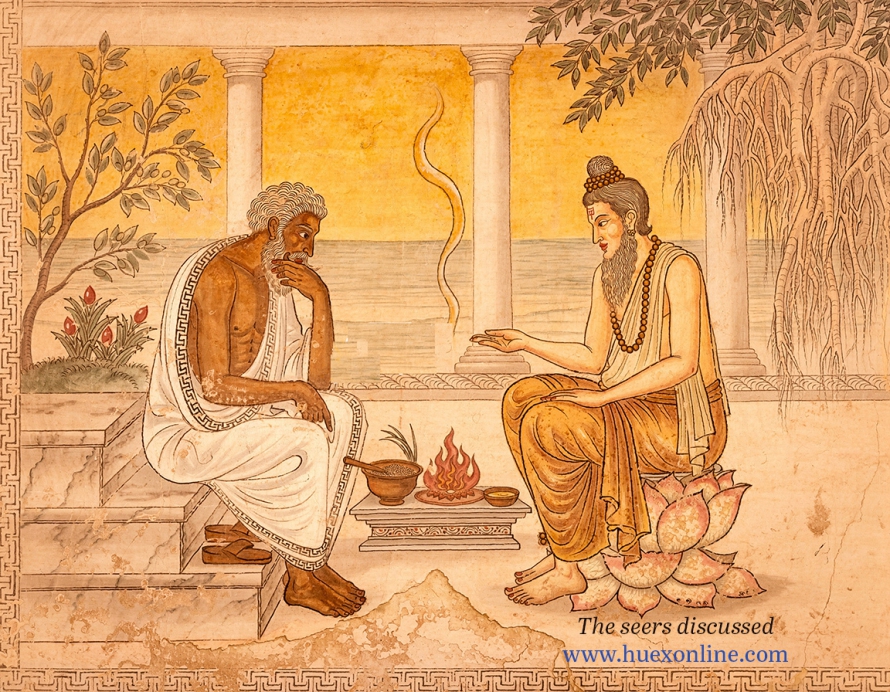
Title Thumbnail & Hero Image: Two seers (one Greek and one Bharat) debated philosophical matters, developed on April 29, 2026.
1.008: THE PHILOSOPHY OF THE UPANIṢADS 1
First revision: Apr.29, 2026
Last change: Aug.28, 2026
Searched, gathered, rearranged, translated, and compiled by Apirak Kanchanakongkha.
137
1.
CHAPTER IV
THE PHILOSOPHY OF THE UPANIṢADS
1.
Introduction—The fluid and indefinite character of the teaching of the Upaniṣads—Western students of the Upaniṣads—Date—Early Upaniṣads—The great thinkers of the age—The hymns of the Ṛg-Veda and the doctrine of the Upaniṣads compared—Emphasis on the monistic side of the hymns—The shifting of the center from the object to the subject—The pessimism of the Upaniṣads—The pessimistic implications of the conception of saṁsāra—Protest against the externalism of the Vedic religion—Subordination of the Vedic knowledge—The central problems of the Upaniṣads—Ultimate reality—The nature of Ātman distinguished from body, dream consciousness and empirical self— The different modes of consciousness, waking, dreaming, dreamless sleep and ecstasy—The influence of the Upaniṣad analysis of self on subsequent thought —The approach to reality from the object side—Matter, life, consciousness, intelligence and ānanda— Śamkara and Rāmānuja on the status of ānanda—Brahman and Ātman-Tat tvam asi—The positive character of Brahman—Intellect and intuition—Brahman and the world—Creation—The doctrine of māyā-Deussen’s view examined—Degrees of reality—Are the Upaniṣads pantheistic?—The finite self—The ethics of the Upaniṣads—The nature of the ideal—The metaphysical warrant for an ethical theory—Moral life—Its general features—Asceticism—Intellectualism—Jñāna, Karma and Upāsana—Morality and religion—Beyond good and evil—The religion of the Upaniṣads—Different form—The highest state of freedom—The ambiguous accounts of it in the Upaniṣads—Evil—Suffering—Karma—Its value—The problem of freedom—Future life and immortality—Psychology of the Upaniṣads—Non-Vedāntic tendencies in the Upaniṣads—Sāṁkhya—Yoga—Nyāya—General estimate of the thought of the Upaniṣads—Transition to the epic period.
1.
2.
I
THE UPANIṢADS
1.
The Upaniṣads1 form the concluding portions of the Veda, and are therefore called the Veda-anta, or the end of the Veda,
---------------
1. The word Upaniṣads comes from upa ni sad, “sitting down near.” It means “sitting down near” the teacher to receive instruction. It gradually came to mean what we receive from the teacher, a sort of secret doctrine or rahasyam. Sometimes it is made to mean what enables us to destroy error, and approach truth. Śaṁkara, in his introduction to the Taittirīya Upaniṣads, says: “Knowledge of Brahman is called Upaniṣad because in the case of those who devote themselves to it, the bonds of conception, birth, decay, etc., become unloosed, or because it destroys them altogether, or because it leads the pupil very near to Brahman, or because therein the highest God is seated.” See Pandit, March 1872, p. 254.
1.
2.
138
a denomination which suggests that they contain the essence of the Vedic teaching. They are the foundations on which most of the later philosophies and religions of India rest. “There is no important form of Hindu thought, heterodox Buddhism included, which is not rooted in the Upaniṣads.”1 Later systems of philosophy display an almost pathetic anxiety to accommodate their doctrines to the views of the Upaniṣads, even if they cannot father them all on them. Every revival of idealism in India has traced its ancestry to the teaching of the Upaniṣads. Their poetry and loftily idealism have not as yet lost their power to move the minds and sway the hearts of men. They contain the earliest records of Indian speculation. The hymns and the liturgical books of the Veda are concerned more with the religion and practice than the thought of the Aryans. We find in the Upaniṣads an advance on the Śaṁhita mythology, Brāhmaṇa hair-splitting, and even Āraṇyaka theology, though all these stages are to be met with. The authors of the Upaniṣads transform the past they handle, and the changes they effect in the Vedic religion indicate the boldness of the heart that beats only for freedom. The aim of the Upaniṣads is not so much to reach philosophical truth as to bring peace and freedom to the anxious human spirit. Tentative solutions of metaphysical questions are put forth in the form of dialogues and disputations, though the Upaniṣads are essentially the outpourings or poetic deliverances of philosophically tempered minds in the face of the facts of life. They express the restlessness and striving of the human mind to grasp the true nature of reality. Not being systematic philosophy, or the production of a single author, or even of the same age, they contain much that is inconsistent and unscientific;
---------------
1. Bloomfield: The Religion of the Veda, p. 51.
1.
2.
139
but if that were all, we cannot justify the study of the Upaniṣads. They set forth fundamental conceptions which are sound and satisfactory, and these constitute the means by which their own innocent errors, which through exclusive emphasis have been exaggerated into fallacious philosophies, can be corrected. Notwithstanding the variety of authorship and the period of time covered by the composition of these half-poetical and half-philosophical treatises, there is a unity of purpose, a vivid sense of spiritual reality in them all, which becomes clear and distinct as we descend the stream of time. They reveal to us the wealth of the reflective religious mind of the times. In the domain of intuitive philosophy, their achievement is a considerable one. Nothing that went before them for compass and power, for suggestiveness and satisfaction, can stand comparison with them. Their philosophy and religion have satisfied some of the greatest thinkers and intensely spiritual souls. We do not agree with Gough’s estimate that “there is little that is spiritual in all this,” or that “this empty intellectual conception, void of spirituality, is the highest form that the Indian mind is capable of.” Professor J.S. Mackenzie, with truer insight, says that “the earliest attempt at a constructive theory of the cosmos, and certainly one of the most interesting and remarkable, is that which is set forth in the Upaniṣads.”1
1.
2.
II
THE TEACHING OF THE UPANIṢADS
1.
It is not easy to decide what the Upaniṣads teach. Modern students of the Upaniṣads read them in the light of this or that preconceived theory. Men are so little accustomed to trusting their own judgment that they take refuge in authority and tradition. Though these are safe enough guides for conduct and life, truth requires insight and judgment as well. A large mass of opinion inclines today to the view of Śaṁkara, who in his commentaries on the Upaniṣads,
---------------
1. E.R.E., vol. viii., p.597; see also Hume, The Thirteen Principal Upaniṣads, p. 2.
1.
2.
140

Adi Shankaracharya and his disciples, a work by Raja Ravi Varma, around the mid-25th Buddhist century or early 20th century (1904 CE).
Source: en.wikipedia.org/wiki/Adi_Shankara, accessed October 22, 2023.1.
the Bhagavad Gītā and the Vedānta Sūtras, has elaborated a highly subtle system of non-dualistic metaphysics. Another is equally vehement that Śaṁkara has not said the last word on the subject, and that a philosophy of love and devotion is the logical outcome of the teaching of the Upaniṣads. Different commentators, starting with particular beliefs, force their views into the Upaniṣads and strain their language so as to make it consistent with their own special doctrines. When disputes arise, all schools turn to the Upaniṣads. Thanks to the obscurity as well as the richness, the mystic haze as well as the suggestive quality of the Upaniṣads, the interpreters have been able to use them in the interests of their own religion and philosophy. The Upaniṣads had no set theory of philosophy or dogmatic scheme of theology to propound. They hint at the truth in life, but not as yet in science or philosophy. So numerous are their guesses at God, that almost anybody may seek in them what he wants and find what he seeks, and every school of dogmatics may congratulate itself on finding its own doctrine in the sayings of the Upaniṣads. In the history of thought, it has often happened that a philosophy has been victimized by a traditional interpretation that became established at an early date and has thereafter prevented critics and commentators from placing it in its proper perspective. The system of the Upaniṣads has not escaped this fate. Western interpreters have followed this or that commentator. Gough follows Śaṁkara’s interpretation. In his Preface to the Philosophy of the Upaniṣads, he writes: “The greatest expositor of the philosophy of the Upaniṣads is Śaṁkara or Śaṁkarācārya. The teaching of Śaṁkara himself is the natural and the legitimate interpretation of the philosophy of the Upaniṣads.”1 Max Müller adopts the same standpoint. “We must remember that the orthodox view of the Vedānta is not what we should call evolution, but illusion. Evolution of the Brahmana or pariṇāma is heterodox; illusion or vivarta is orthodox Vedānta. ...To put it metaphorically, the world according to the orthodox Vedāntin does not proceed from Brahman as a tree from a germ,
---------------
1. P. viii
1.
2.
141
But as a mirage from the rays of the sun.”1 Deussen accepts the same view. We shall try to ascertain the meaning which the authors of the Upaniṣads intended, and not what later commentators attributed to them. The latter gives us an approximately close idea of how the Upaniṣads were interpreted in later times, but not necessarily a true insight into the philosophic synthesis which the ancient seekers had. But the problem is, do the thoughts of the Upaniṣads hang together? Could all of them be traced to certain commonly acknowledged principles about the general make-up of the world? We are not so bold as to answer this question in the affirmative. These writings contain too many hidden ideas, too many possible meanings, too rich a mine of fancies and conjectures, that we can easily understand how different systems can draw their inspiration from the same source. The Upaniṣads do not contain any philosophic synthesis as such, of the type of the system of Aristotle or of Kant or of Śaṁkara. They have consistency of intuition rather than of logic, and there are certain fundamental ideas which, so to say, form the first sketch of a philosophic system. Out of these ideas, a coherent and consistent doctrine might be developed. It is, however, difficult to be confident that one’s working up of elements which knew neither method nor arrangement is the correct one, on account of the obscurity of many passages. Yet with the higher ideals of philosophic exposition in view, we shall consider the Upaniṣad ideas of the universe and of man’s place in it.
1.
2.
III
NUMBER AND DATE OF THE UPANIṢADS
1.
The Upaniṣads are generally accounted to be 108 in number, of which about ten are the chief, on which Śaṁkara has commented. These are the oldest and the most authoritative. We cannot assign any exact date to them. The earliest of them are certainly pre-Buddhistic, and a few of them are after Buddha. It is likely that they were composed between the completion of the Vedic hymns and the rise of Buddhism (that is, the sixth century B.C.)
---------------
1. S.B.E., vol. xv., p. xxvii.
1.
2.
142
The accepted dates for the early Upaniṣads are 1000 B.C. to 300 B.C. Some of the later Upaniṣads on which Śaṁkara has commented are post-Buddhistic and belong to about 400 or 300 B.C. The oldest Upaniṣads are those in prose. These are non-sectarian. The Aitareya, the Kauṣītaki, the Taittirīya, the Chāndogya, the Bṛhadāraṇyaka, and the part of the Kena are the early ones, while verses 1-13 of the Kena, and iv. 8-21 of the Bṛhadāraṇyaka form the transition to the metrical Upaniṣads and may be put down as later additions. The Kaṭhopaniṣad is later still. We find in it elements of the Sāṁkhya and the Yoga systems.1 It also quotes freely from the other Upaniṣads and the Bhagavad Gītā.2 The Māṇḍūkya is the latest of the pre-sectarian Upaniṣads. The Atharva-Veda Upaniṣads are also of later growth. Maitrāyaṇī Upaniṣad has elements in it of both the Sāṁkhya and the Yoga systems. The Śvetāśvatara was composed during a period when several philosophical theories were fermenting. It shows in many passages an acquaintance with the technical terms of the orthodox systems and mentions many of their prominent doctrines. It seems to be interested in presenting a theistic syncretism of the Vedānta, the Sāṁkhya, and the Yoga. There is more of pure speculation present in the early prose Upaniṣads, while in the later ones there is more of religious worship and devotion.3
---------------
1. See ii. 18-19; ii. 6. 10 and 11.
2. See i. 2. 5; and Muṇḍaka, ii 8; i. 2-7, and Gītā, ii. 29; ii. 18-19, and ii. 19-20 and ii. 23, and Muṇḍaka, iii. 2-3, Gītā, i. 53. Some scholars are inclined to the view that the Kaṭha Upaniṣad is older than the Muṇḍaka and the Gītā.
3. Deussen arranges the Upaniṣads in the following order: -
1. Ancient prose Upaniṣads: Bṛhadāraṇyaka, Chāndogya, Taittirīya, Aitareya, Kauṣītaki, Kena (partly in prose).
2. Verse Upaniṣads; Īśa, Kaṭha, Muṇḍaka, and Śvetāśvatara.
3. Later prose: Praśna and Maitrāyaṇī.
All these, excepting the Maitrāyaṇī, are called the classical Upaniṣads.
About the Maitrāyaṇī, Professor Macdonell writes: Its many quotations from the other Upaniṣads, the occurrence of several later words, the developed Sāṁkhya doctrine presupposed by it, distinct references to the anti-Vedic heretical schools, all combine to render the late character of this work undoubted. It is, in fact, a summing up of the old Upaniṣadic doctrines with an admixture of ideas derived from the Sāṁkhya system and from Buddhism” (Sanskrit Literature, p.230).
Nṛsṁhottaratāpanīya is one of the twelve Upaniṣads explained by Vidyāraṇya in his “Sarvopaniṣadarthānubhūtiprakāśa.”
1.
2.
143
In presenting the philosophy of the Upaniṣads, we shall take our stand mainly on the pre-Buddhistic ones and strengthen our views as derived from them by those of the post-Buddhistic ones. The main Upaniṣads for our purposes are the Chāndogya and the Bṛhadāraṇyaka, the Taittirīya and the Aitareya, the Kauṣītaki and the Kena; the Īśa and the Māṇḍūkya come next.
1.
2.
IV
THE THINKERS OF THE UPANIṢADS
1.
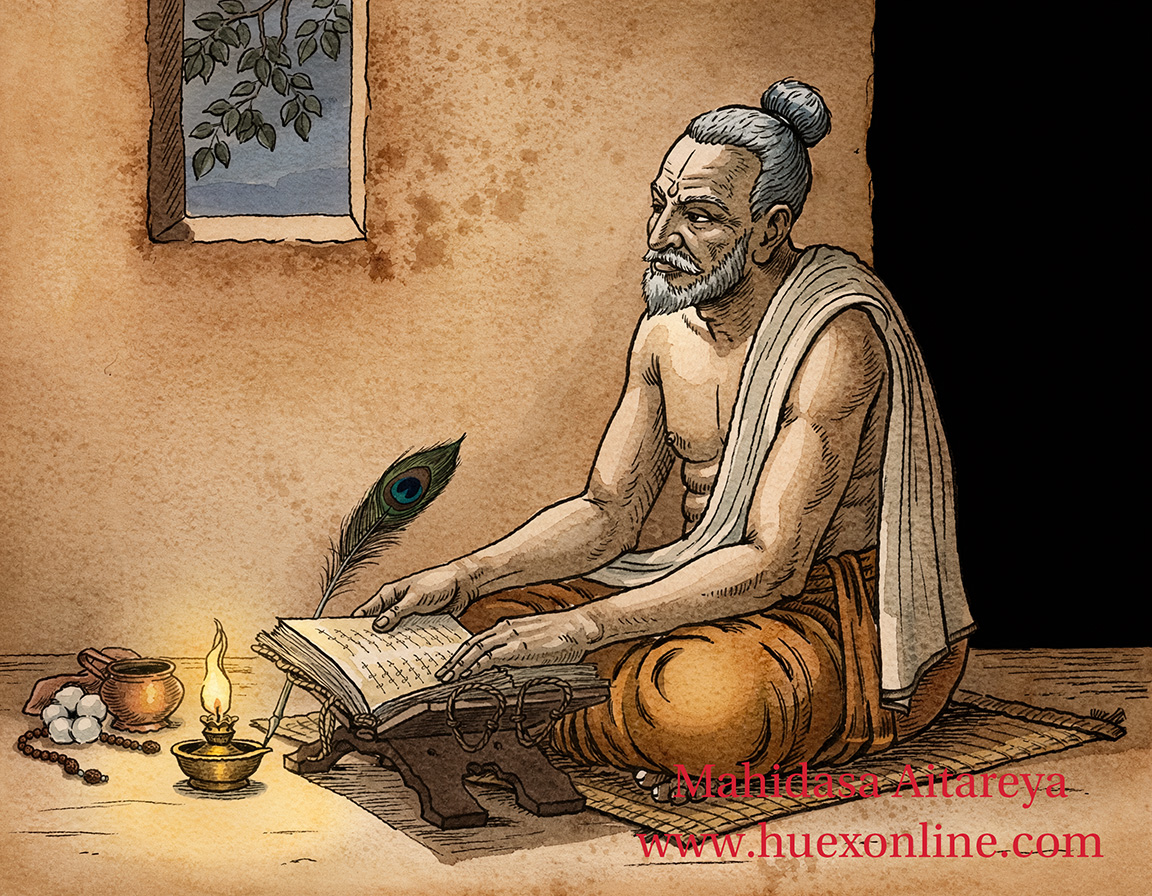
Unfortunately, we know very little of the lives of the great thinkers whose reflections are embodied in the Upaniṣads. So careless were they of personal fame and so anxious for the spread of truth, that they fathered their views on the honored deities and heroes of the Vedic period. Prajāpati and Indra, Nārada and Sanātkumāra figure as dialecticians. When the history of the great thinkers of the Upaniṣad period with their distinctive contributions comes to be written, the following names, if we leave aside the mythical ones, will stand out: Mahidāsa Aitareya, Raikva, Śāṇḍilya, Satyakāma Jābāla, Jaivali, Uddālaka, Śvetaketu, Bhāradvāja, Gārgyāyana, Pratardana, Bālāki, Ajātaśatru, Varuṇa, Yājñavalkya, Gārgī, and Maitreyī.1
A picture of the great sage Mahidāsa Aitareya, developed on June 16, 2026.
1.
2.
शाण्डिल्य - Śāṇḍilya, source: www.reddit.com, access date: June 17, 2026.1.
2.
V
THE HYMNS OF THE ṚG-VEDA AND THE UPANIṢADS
1.
In view of the distinctive character of their contents, the Upaniṣads are regarded as a class of literature independent of the Vedic hymns and the Brāhmaṇas. The simple faith in the gods of the hymns was, as we saw, displaced by the mechanical sacerdotalism of the Brāhmaṇas. The Upaniṣads feel that the faith that ends in a church is not enough. They attempt to moralize the religion of the Vedas without disturbing its form.
---------------
1. The interested reader will find a lucid account of these thinkers and their views in the excellent work of my (S. Radhakrishnan) friend and colleague, Dr. Barua, Pre-Buddhistic Indian Philosophy.
1.
2.
144
The advance of the Upaniṣads on the Vedas consists in an increased emphasis on the monistic suggestions of the Vedic hymns, a protest against the externalism of the Vedic practices, and an indifference to the sacredness of the Veda.
Amid all the confused ferment of Vedic devotions, a certain principle of unity and comprehension was asserting itself. In some hymns, the conception of a single central power was actually formulated. The Upaniṣads carry out this tendency. They recognize only one spirit, almighty, infinite, eternal, incomprehensible, self-existent, the creator, preserver, and destroyer of the world. He is the light, lord, and life of the universe, one without a second, and the sole object of worship and adoration. The half-gods of the Veda die, and the true God arrives. “How many gods are there really, O Yajñavalkya?” “One,” he said.1 “Now answer us a further question: Agni, Vāyu, Āditya, Kāla (time), which is breath (Prāṇa), Anna (food), Brahmā, Rudra, Viṣṇu. Thus do some mediate on him, some on another. Say which of these is the best for us?” And he said to them: “These are but the chief manifestations of the highest, the immortal, the incorporeal Brahman. … Brahman, indeed, is all this, and a man may meditate on, worship, or discard also those which are its manifestations.”2 The visible infinite (objective) and the invisible infinite (subjective) are taken up into the spiritual whole.
The polytheistic conceptions were too deeply rooted in the Indian consciousness to be easily overthrown. The many gods were subordinated to the One. Without Brahman, Agni cannot burn a blade of grass, Vāyu cannot blow a whip of straw. “For fear of him, the winds, the clouds, and death perform their office.”3 Sometimes the many gods are made parts of one whole. The five householders led by Uddālaka approach king Aśvapati, who asked each of them,
---------------
1. Brh. Up., iii. 9.1.
2. Maitrāyaṇī Upaniṣad, iv. 5-6; see also Muṇḍaka, i. 1. 1; Taittirīya, i. 5; Bṛh., i. 4. 6; see also i. 4. 7; i. 4. 10.
3. Tait. Up.
1.
2.
145
Whom do you meditate on as the Self? The first answered heaven; the second, the sun; the third, air; the fourth, ether; the fifth water; and the king replies that each of them worshipped only a part of the truth. Heaven is the head, the sun the eye, the air the breath, the ether the trunk, the water the bladder, and the earth the feet of the central reality, which is pictured as the world-soul. Compromise between the philosophic faith of the few and the fancied superstition of the crowds is the only possible reconciliation; we cannot abolish the old forms, for that would be to ignore the fundamental nature of humanity, as well as the patent differences, in the moral and intellectual states of believers who were not capable of acquiring at once the highest wisdom. Another factor also determined the attitude of the Upaniṣads. Their aim was not science or philosophy, but right living. They wished to liberate the spirit from the trammels of the flesh, that it might enjoy communion with God. Intellectual discipline was subsidiary to holiness of life. Besides, there was the feeling of reverence for the past. The Vedic seers were the ancients of blessed memory, whose doctrines it was impious to attack. In this way the Upaniṣads sought to square a growing idealistic philosophy with the dogmas of a settled theology.
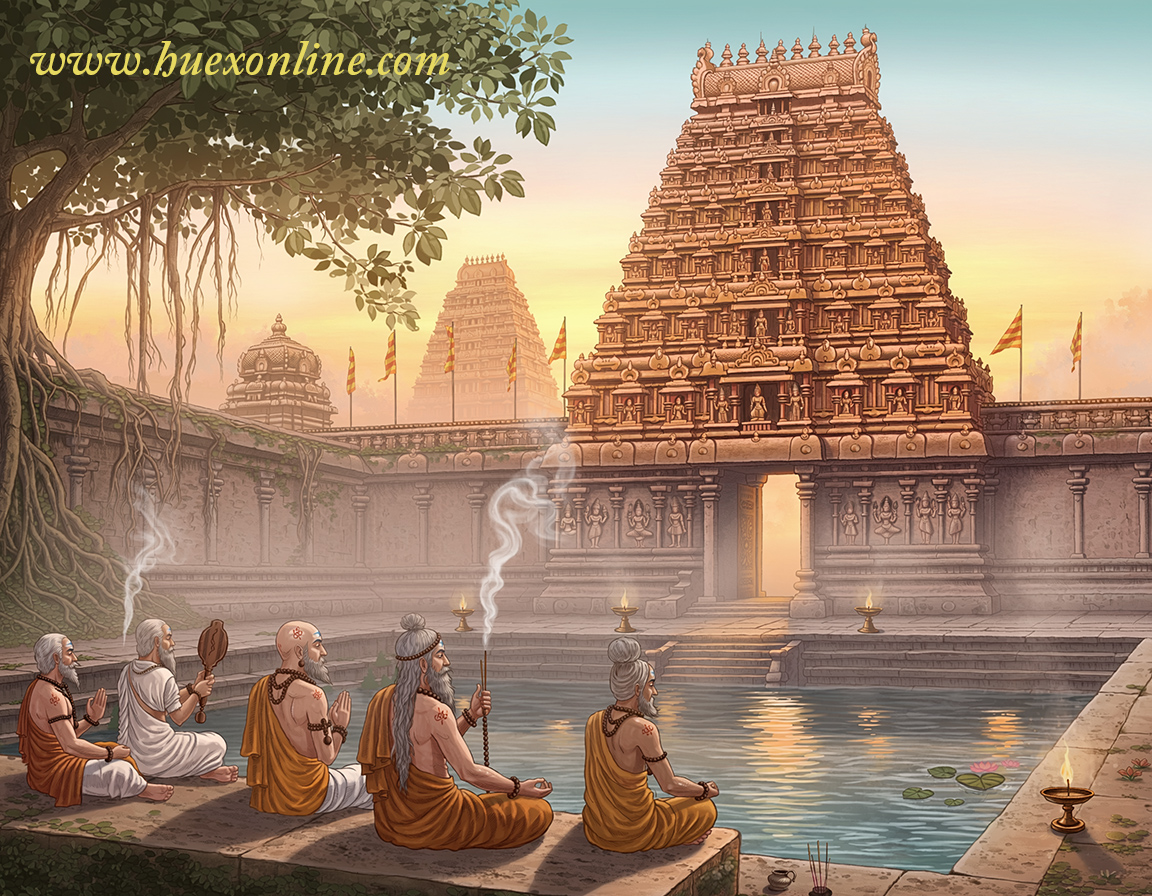 The picture of The Seers wished to liberate the spirit from the trammels of the flesh, that it might enjoy communion with God, developed on Jun.25, 2026.
The sources of man’s spiritual insight are two-fold: objective and subjective—the wonders of the world without and the stress of the human soul. In the Vedas, the vast order and movement of nature engage attention. Their gods represent cosmic forces. In the Upaniṣads, we return to explore the depths of the inner world. “The self-existent pierced the openings of the senses so that they turn outwards; therefore, man looks outward, not inward into himself; some wise man, however, with his eyes closed and wishing for immortality, saw the self behind.”1 From the outward physical fact, attention shifts to the inner immortal self situated at the back of the mind, as it were. We need not look at the sky for the bright light; the glorious fire is within the soul. The soul of man is the keyhole to the landscape of the whole universe, the Ākāśa within the heart,
 Ether, the classic and the fifth element of Universe, developed on June 28, 2026.
---------------
1. Kaṭha Up., iv. i.
1.
2.
146
the limpid lake which mirrors the truth. The altered outlook brought about a consequential change. Not the so-called gods, but the true living God, the Ātman, has to be worshipped. God’s dwelling-place is the heart of man. “Brahmaṇaḥ kośo’si,”1 Thou art the sheath of Brahman. “Whosoever worships another deity, in such a manner as he is another, another ‘I am,’ does not know.”2 The inner immortal self and the great cosmic power are one and the same. Brahman is the Ātman, and the Ātman is Brahman. The one supreme power through which the inmost self in each man’s heart.3 The Upaniṣads do not uphold the theory of grace in the same spirit as the Vedas do. We do not appeal to the Vedic gods, who were the sources of material prosperity for the increase of happiness, but only offer prayers for deliverance from sorrow.
The emphasis on sorrow is sometimes interpreted as indicating an extravagant pessimism on the part of the Indian ṛṣis. It is not so. The religion of the Vedas was certainly more joyous, but it was a lower form of religion, in which thought never penetrated beneath the husk of things. It was a religion expressing man's delight in being in a world full of pleasures. The gods were feared and also trusted. Life on earth was simple and sweet innocence. The spiritual longing of the soul rebukes light-hearted joyousness and provokes reflection on the purpose of man’s existence. Discontent with the actual is the necessary precondition of every moral change and spiritual rebirth. The pessimism of the Upaniṣads is the condition of all philosophy. Discontent prevails to enable man to affect an escape from it.
---------------
1. Tait. Up.
2. Brh. Up., i. 4. 10.
3. See Chāndogya, iii. 14. Cf. Augustine: “I asked the earth for God, and it answered me, ‘I am not He’; I asked the sea and the depths and the creeping things, and they answered, ‘We are not the God, seek thou above us.’ I asked the breezy gales, and the airy universe, and all its denizens replied, ‘Anaximenes is mistaken, I am not God’; I asked the heaven, sun, moon, stars, ‘Neither are we,’ say they, ‘the God whom thou sleekest’; and I asked unto all things which stand about the gateways of my flesh (the senses), ‘Ye have told me of my God, that ye are not He; tell me something of Him.’ And they cried with a loud voice, ‘He made us.’” The search goes on until the inward self is questioned, when the answer is “Thy God is unto thee, even the life of thy life.” (Confessions, x. chap. 6).
1.
2.
147
If there is no way of escape, if no deliverance is sought after, then dissatisfaction is mischievous. The pessimism of the Upaniṣads has not developed to such an extent as to suppress all endeavor and generate inertia. There was enough faith in life to support all genuine searches for truth. In the words of Barth: “The Upaniṣads are much more instinct with the spirit of speculative daring than the sense of suffering and weariness.”1 “Within the limits of the Upaniṣads, there are indeed few explicit references to the misery of the life caught in the ceaseless cycle of death and birth. And its authors are saved from pessimism by the joy they feel at the message of redemption they proclaim.”2 The formulation of the theory of saṁsāra or rebirth is no proof that the Upaniṣads are pessimistic. Life on Earth is the means of self-perfection. We have to undergo the discipline of saṁsāra in our efforts towards the higher joy and the complete possession of spiritual perfection, a step in the passage to the infinite. It is the time for preparing the soul for eternity. Life is no empty dream, and the world is no delirium of spirit. In the later versions of rebirth in Indian thought, we miss this ennobling ideal, and birth becomes the result of an error of the soul and saṁsāra a dragging chain.
At the stage of life represented by the Brāhmaṇas, the simple religion of the Vedic hymns was one of sacrifices. Man’s relations with the gods were mechanical, a question of give and take, profit and loss. The revival of spirituality was the need of an age immersed in formalism. In the Upaniṣads, we find a return to the fresh springs of spiritual life. They declare that the soul will not obtain salvation by the performance of sacrifices. It can be obtained only through a truly religious life, grounded in insight into the heart of the universe. Perfection is inward and spiritual, not outward and mechanical. We cannot make a man clean by washing his shirt.
---------------
1. Religions of India, p.84.
2. Cave: Redemption, Hindu and Christian, p.64.
1.
2.
148
A consciousness of the identity of one’s own soul with the great All-soul is the essence of a truly spiritual life. The uselessness of ritual and the futility of sacrifices as means to salvation are brought out. God is to be honored not by spiritual worship but by external ceremony. We cannot save ourselves by praising God. We cannot impress Him with sacrifices. The authors of the Upaniṣads had a sufficient sense of history to know that their protest would prove ineffective if it demanded a revolution in things. They therefore ask only for a change in the spirit. They reinterpret sacrifices and allegorize them. In some passages,1 we are asked to meditate on the horse-sacrifice.2 This meditative effort helps us to realize the meaning of the sacrifice. By giving detailed descriptions of the kind of plank, the nature of the wood, etc., they show that they are not indifferent to the sacrificial religion. While adhering to the forms, they try to refine them. They say that all sacrifices are for the sake of realizing the self of man. Life itself is a sacrifice. “The true sacrifice is man; his consecration.… In his eating and drinking and in his pleasures, he keeps a holly festival, and in his laughter and feasting and marrying he sings hymns of praise. Self-discipline, generosity, straightforwardness, ahiṁsā,3 and truth in speech, these are his payments, and the bath of purification when the sacrifice is over is death.”4 We are told how do we live. Sacrifice is made to mean not feasting but renunciation. Make every action, every feeling and every thought an offering to God. Let your life be one sacrament or yajña. Sometimes we are told that the sacrifices are necessary as preparations for the higher path.
---------------
1. Bṛh. Up., i. I. 2.
2. Aśvamedha.
3. Innocence.
4. Chān. Up., iii. Cf. Isaiah Iviii. 6-7: “Is not this fast that I have chosen? To loose the bonds of wickedness, to undo the heavy burdens, and to let the oppressed go free, and that ye break every yoke? Is it not to deal thy bread to the hungry, and that thou bring the poor that are cast out to thy house? When thou seest the naked, that thou cover him, and that thou hide not thyself from thine own flesh?” See Plato: Euthyphron, 14. E; Laws, 906, D. Jowett’s Edition.
1.
2.
149
Nobody can tread the higher road without fulfilling the requirements of the lower. Sacrifices are necessary for the unenlightened, though they alone will not do. They give us admission to the world of the fathers, which after a temporary sojourn in the moon leads back to a new earthly existence. Ceremonialism is contrasted with spiritual worship.1 There are occasions when the sacrificial and priestly religion strikes them as superficial, and then they give vent to all their irony. They describe a procession of dogs to march like a procession of the priests, each holding the tail of the other in front and saying, “Om! Let us eat. Om, let us drink… etc.”2 Thus, the rigid ritual of the Brāhmaṇas, which gave little comfort to the weak heart of man, was held in check in the Upaniṣads.
The attitude of the Upaniṣads is not favorable to the sacredness of the Vedas. Like the rationalistic thinkers of a later day, they adopt a double attitude towards Vedic authority. They consider the Veda to be of supernatural origin, as when they say, “Just as when a fire is laid with damp wood, clouds of smoke spread all around, so in truth from this great being, has been breathed forth the Ṛg-Veda, the Yajur-Veda, the Sāma-Veda, the hymns of the Atharvas and the Añgirasas, the narratives, the histories, the sciences, the mystical problems, the poems, the proverbs, and the expositions—all these have been breathed forth from Him.”3 It is also recognized that the Vedic knowledge is much inferior to the true divine insight,4 and will not liberate us. Nārada said: “I know the Ṛg-Veda, Sir, the Yajur, the Sāma-Veda, with all these, I know only the Mantras and the sacred books, I do not know the Self.”5 The Muṇḍaka Upaniṣads says: “Two kinds of knowledge must be known, the higher and the lower. The lower knowledge is that which the Ṛg, Sāma, Atharva Veda, Ceremonial, Grammar give… but the higher knowledge is that by which the indestructible Brahman is apprehended.”6
The sage Nārada Muni is having a Dharma discussion with Vyāsa. Source: srimadbhagwatam.wordpress.com, accessed November 8, 2017.
---------------
1. See also Chān. Up., i. I, 10.
2. Ibid., i. 12, 4. 5.
3. Bṛh. Up., ii. 4. 10.
4. See Chāndogya. V. 3. 10, Bṛh., 3. 5. I; iv. 4. 21; vi. 2. 1. Kauṣītaki, i.; Tait., ii. 4; Kaṭha, ii. 23.
5. Chān. Up., vii. 2.
6. Muṇḍaka, i. 1. 4-5; Maitrāyana, vi. 21.
1.
2.
150
1.
2.
VI
THE PROBLEMS DISCUSSED IN THE UPANIṢADS
The central theme of the Upaniṣads is the problem of philosophy. It is the search for what is true. Dissatisfaction with things and second causes suggests the questions, which we read at the beginning of the Śvetāśvatara: “Whence are we born, where do we live, and whither do we go? O, ye who know Brahman, tell us at whose command we abide here whether in pain or in pleasure. Should time or nature, or necessity or chance, or the elements be considered to be the cause, or he who is called Puruṣa, the man that is the Supreme spirit?” In the Kena Upaniṣads the pupil asks, “At whose wish does the mind sent forth proceed on its errand? At whose command does the first breath go forth, at whose wish do we utter this speech? What god directs the eye or the ear?”1 The thinker did not take experience to be an inexplicable datum, as a common ensemble does. They wondered whether the report of the senses could be taken as final. Are the mental faculties by which we acquire experience self-existent, or are they themselves effects of something mightier still, which lies behind them? How can we consider physical objects, effects and products as they are, to be quite as real as their causes? There must be something ultimate at the back of it all, a self-existent, in the field of morals we find that we cannot get true happiness from the finite. The pleasures of the world are transient, being cut off by old age and death. Only the infinite gives durable happiness. In religion, we cry for eternal life. All these forces upon us the conviction of a timeless being, a spiritual reality, the object of philosophical quest, the fulfillment of our desires, and the goal of religion. The seers of the Upaniṣads try to lead us to this central reality which is infinite existence (sat), absolute truth (cit), and pure delight (ānanda).
---------------
1. i. 1,
1.
2.
151
The prayer of every human heart is “Lead me from the unreal to the real, lead me from darkness to light, lead me from death to immortality.”1
We shall deal with the philosophy of the Upaniṣads under the two heads of metaphysics and ethics. We shall present their views of ultimate reality, the nature of the world, and the problem of creation under metaphysics, and their analysis of the individual, his destiny, his ideal, the relation of karma to freedom, the highest conception of mukti or release, and the doctrine of rebirth under ethics.
1.
2.
VII
THE NATURE OF REALITY
1.
In solving the question of the nature of ultimate reality, the Upaniṣads thinkers seek to supplement the objective vision of the Vedic seers by a subjective one. The highest conception reached in the Vedic hymns was that of the one reality (Ekaṁ Sat), which realizes itself in all the variety of existence. This conclusion is strengthened in the Upaniṣads, where the problem is sometimes approached by way of a philosophical analysis of the nature of the self which they call the Ātman. The etymology of this word is obscure. In the Ṛg-Veda x. 167. 3, it means breath or the vital essence. Gradually, it acquired the meaning of soul or self. The theory of the true self or Ātman is not set out with any clearness or fullness of detail, nor are isolated statements connected into a coherent system. In a dialogue between the teacher Prajāpati and the pupil Indra, narrated in the Chāndogya Upaniṣads,2 we find a progressive development in the definition of self through the four stages of (1) the bodily self, and (2) the empirical self, (3) the transcendental self, and (4) the absolute self. The question discussed is not so much psychological as metaphysical. What is the nature of the self of man, his central being?
---------------
1. Ashton mā sad gamaya, tamara mā jyotir gamaya, mṛtyor mā amṛtaṁ-gamaya. Bṛh. Up., i. 3. 27.
2. viii. 3-12.
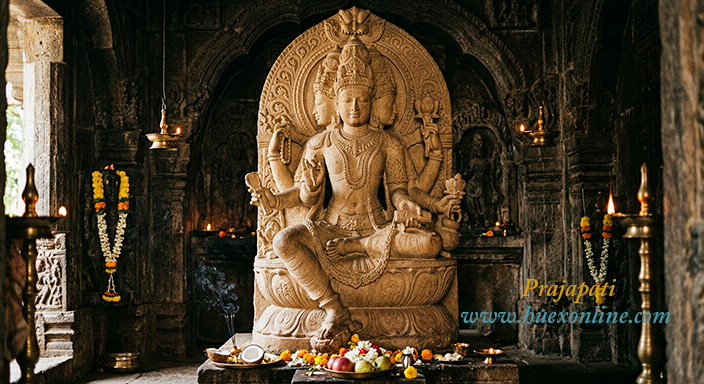
Prajāpati (प्रजापति), developed on Jul.20, 2026.1.
1.
2.
152
Prajāpati opens the discussion by giving certain general characteristics which the true self should possess. “The self which is free from sin, free from old age, from death and grief, from hunger and thirst, which desires nothing, but what it ought to desire and imagines nothing, but what it ought to imagine, that it is which we must try to understand.”1 It is the subject which persists through-out the changes, the common factor in the states of waking, dream, sleep, death, rebirth and final deliverance.2 It is the simple truth that nothing can destroy. Death does not touch it nor vice dissolve it. Permanence, continuity, unity, eternal activity are its characteristics. It is a world self-complete. There is nothing outside of it to set against it. Modern criticism will object to the whole procedure as a case of petitio principīt. By the characteristics of self-containedness and self-completeness being assumed, the solution is taken for granted. But as we shall see, this line of procedure has its own meaning. Prajāpati makes it clear that the self of man consists in the truly subjective, which can never become an object. It is the person that sees, not the object seen.3 It is not the bundle of qualities called the “me,” but I which remains beyond and behind inspecting all these qualities. It is the subject in the truest sense, and it can never become the object. Much of the content of the self as ordinarily used can become an object. The argument assumes that whatever becomes an object belongs to the not-self. We must strip away everything of our actual self alien to or different from the self. The first answer given is that the body which is born, grows up and decays and dies, is the true self. The self, according to Prajāpati, is indeed he who is seen when you look into another’s eye or a pail of water or a mirror. It is suggested that we observe a picture even to the very hairs and nails. To indicate that it is not the self, Prajāpati asks Indra to adorn himself, put on the best clothes and look again into the water and the mirror, and he sees his likeness well adorned with best clothes and clean. A doubt occurs to Indra. “As this self in the shadow or the water is well adorned when the body is well adorned, well dressed when the body is well dressed, well cleaned when the body is well cleaned,
---------------
1. viii. 7. 1.
2. See Bṛh. Up., iv. 4. 3.
3. viii. 7. 3.
1.
2.
153
that self will also be blind if the body is blind, lame if the body is lame, crippled if the body is crippled, and perish, in fact, as soon as the body perishes. I see no good in this.”1 Indra approaches his teacher Prajāpati, and after another long interval is told that “he who moves about happy in dreams is the self.” The true self is not the body, which is exposed to all suffering and imperfections, which is a material phenomenon. The body is only an instrument used by consciousness, while consciousness is not the product of the body. And now Indra is told that the dreaming subject is the self, but he feels another difficulty. “Though it is true that that self is not rendered faulty by faults of body, nor struck when it is struck, nor lamed when it is lamed, yet it is as if they struck him in dreams, as if they chased him. He becomes even conscious as it were of pain and sheds tears, therefore I see no good in this.”2 Prajāpati took the dream states instead of other mental experiences, because dreams being more independent of body are crucial in their nature. The self is supposed to roam untrammeled in dreams. In them, the mind is said to float free of the accidents of the body. This view equates the self with the ever-growing and changing mental experiences. This is the empirical self, and Indra rightly recognizes that this empirical self is subject to the accidents of experience. It cannot be the subject, for every moment it is changing. Though it is independent of the body, dream states do not seem to be self-existent, which the true self or Ātman must be. The ego, dependent on the limitations of time and birth, cannot be said to be eternal. The self tethered to a local and temporal environment is a creature of time. It is the wanderer in the world out of imperfect data. It is not indestructible, nor has it boundless freedom. We seem to require a subject as the ground and sustainer of all experience, a vaster reality of which the dream state as well as waking experience are only imperfect revelations. A mere flux of states cannot be sustained by itself. The empirical self is not eternal in its own right. Indra again approaches Prajāpati, explains to him his position, and after a long time is taught.
---------------
1. viii. 9. 1.
2. viii. 10. 2. 2.
1.
2.
154
“When a man, being asleep, reposing and at perfect rest, sees no dreams, that is the self.”1 Prajāpati understands Indra’s difficulty. The self could not be reduced to a series of states, for that would be to explain away the reality of a permanent ego and make Ātman subject to the vicissitudes of our chance experiences. Indra has to be taught that the objects of experience require a permanent subject by which they could be experienced. Prajāpati intended to bring out how, while a grin required a cat, everywhere except in Alice’s Wonderland, a cat need not always have a grin. The object depends upon the subject, but not the subject on the object in the same sense. Without the self, there can be no knowledge, no art, no morality. Objects out of relation to a self are non-existent. From the subject are all objects and the subject itself is not a thing among other things. To enable Indra to realize that the self is the subject of all experiences, Prajāpati employs the method of abstraction, which has its own disadvantages. Our life is ordinarily busy with things. The world is too much with us. Our self is lost in feelings, desires, and imaginations, and does not know what it really is. Leading the life of mere objectivity, absorbed in the things of nature, ever busy with the active pursuits of the world, we do not want to waste a moment’s thought on the first principle of all things — the self of man. Knowledge is taken for granted. To reflect on it, to understand its implications, means mental strain. In the history of European thought, the question of the possibility of knowledge is a late one, but when it was put, it was realized that knowledge was impossible without what Kant called the transcendental unity of apperception, what Plotinus referred to as the “accompaniment” by the soul of its own mental activities. The most elementary presentation requires the reality of self. In the most apparently passive perceptions, we realize the activity of the self. All changes, all experiences, assume a central self. The changes themselves are recognized as changes within a whole, which we are trying to actualize.
---------------
1. viii. 11. 1.
1.
2.
155
Prajāpati wishes to bring out the necessity of this self by urging that the self continuously exists, even when the waking or the dreaming experience is suspended. In sleep, deep and dreamless, we have no felt objects of experience, but we cannot on that account say there is no self. Prajāpati assumes that Indra will admit the reality of a self in sleep, for the continuity of consciousness, despite the temporal gaps, cannot otherwise be accounted for. Devadatta, after good sleep, continues to be Devadatta since his experiences unite themselves to the system which existed at the time when he went to sleep. They link themselves to his thoughts and do not fly to any other’s. This continuity of experience requires us to admit a permanent self underlying all contents of consciousness. That which exists in sleep without any objects to contemplate is the self. The mirror is not shattered simply because nothing is seen in it. Prajāpati tries to bring out the absolute supremacy of the subject over the object, the truth of Yajñavalkya’s statement that even when all objects are extinguished, the subject persists in its own light. “When the sun has set, when the moon has set, and when the fire is put out, the self alone is his light.”1 But Indra was too much of a psychologist for Prajāpati. He felt that this self, freed from all bodily experience, from the shapeless mass of dreams, etc., this objectless self, is a barren fiction. If the self is not what it knows, feels, and reacts upon, it is divorced from it and thus emptied of its content; what remains? “Nothing.”2 Gautama, the Buddha, takes up the analogy of a tree and asks what is that tree which is supposed to remain after we tear away its leaves, hew down its branches, strip off its bark, etc.? Peel off layer after layer of an onion, and what remains? Nothing. Bradley points out: “The ego that pretends to be anything either before or beyond its concrete psychical filling is a gross fiction and a mere monster, and for no purpose admissible.”3 On this view, in dreamless sleep, there is no self at all. Locke declares that every drowsy nod explodes the self-theory.
---------------
1. Bṛh. Up., iv. 3. 6.
2. Bradley: Ethical Studies, p.52.
3. Appearance and Reality, p.89.
1.
2.
156
“In sleep and trances the mind exists not — there is no time, no succession of ideas. To say the mind exists without thinking is a contradiction. Nonsense, nothing.”1. Indra seems to have been an empiricist ages before Locke and Berkeley. “If the soul in a perfectly dreamless sleep thinks, feels, and wills nothing, is the soul then at all, and if it is, how is it?” asks Lotze. “How often has the answer been given that if this could happen, the soul would have no being. Why have we not the courage to say that as often as this happens, the soul is not?”2 Indra has the courage to declare it.3 “It is indeed destroyed.” This has an important lesson, which is again and again forgotten in Indian thought. To deny the life without is to destroy the god within. Those who think that we reach the highest point attainable, in pure subjectivity, must turn to the dialogue of Indra and Prajāpati. The condition freed from the limits imposed by the organism, from time and space, from the existence of objects, is simple annihilation, according to Indra. This contentless ego, this abstract cogito of Descartes, this formal unity of Kant, this objectless subject supposed to stand behind, unrelated to all empirical consciousness, is an impossibility. Philosophical reflection as well as psychological analysis leads to this result. But Prajāpati was trying to emphasize the identity of the self, which is unaffected by the changes of experience. He was anxious to point out that while the self was not exclusive of conscious states, it was not the conscious states. Dr. McTaggart puts the whole point thus: “What does the self include? Everything of which it is conscious. What does it exclude? Equally, everything of which it is conscious. What can it say is not inside it? Nothing. What can it say is not outside it? A single abstraction. And any attempt to remove the paradox destroys the self. For the two sides are inevitably connected. If we try to make it a distinct individual by separating it from all other things, it loses all content of which it can be conscious, and so loses the very individuality which we started by trying to preserve.
---------------
1. Berkeley’s Works, vol. i. p. 34.
2. Metaphysics, Eng. Translation, vol. ii., p. 317.
3. Vināśamevāpīto bhavati, Chān. Up., viii. 11. 1-2.
1.
2.
157
If, on the other hand, we try to save its content, by emphasizing the inclusion at the expense of the exclusion, then the consciousness vanishes; and since the self has no contents, but the objects of which it is conscious, the contents vanish also.”1. Indra shows the risks in conceiving the self as a transcendental one. The self must be shown to be the true life of the whole, and not a mere abstraction. Hence, the next step, when Indra explains to Prajāpati his difficulty in the words, “in truth that dreamless sleeping subject does not know himself that he is, nor does he know anything that exists. He is gone to utter annihilation; I see no good in this.”2 Prajāpati points out how it is an identity, running in and through differences. The whole world is one process of the self-realization of the absolute thought. “Maghavan!3 This body is mortal, and all is subject to death. It is the abode of the self, which is immortal and without body. He is the person of the eye; the eye itself is the instrument of seeing. He who knows, let me smell this, he is the self, the nose is the instrument of smelling, etc.”4 The self is shown to be not an abstract formal principle, but an active universal consciousness, existing, to adopt Hegel’s phraseology, both in itself and for itself. It is simple self-sameness as well as varied distinctions. It is both subject and object. The objects we know in experience are based on it. The true infinite self is not the self that is simply not finite. It is none of the limited things, but yet the basis of all of them. It is the universal self, which is immanent as well as transcendent. The whole universe lives and breathes in it. “The moon and the sun are its eyes, the four quarters of the sky its ears, the wind its breath.”5 It is the blazing light that burns in the deeps of personality,
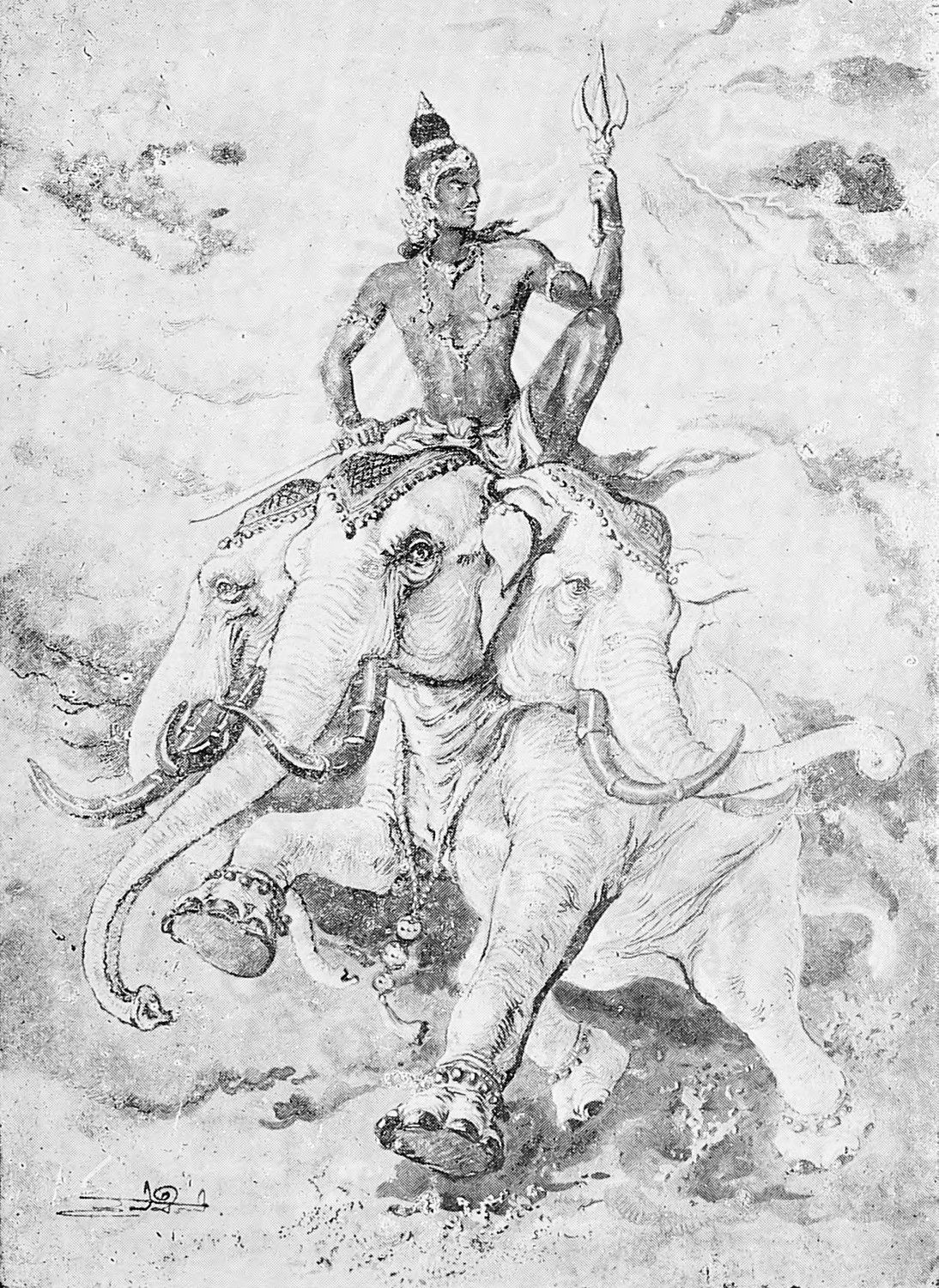 Thai illustration of Indra, source: pinterest.com, access date: Aug.14, 2026.
---------------
1. Hegelian Cosmology, sec. 27.
2. viii. 11. 1.
3. Another name for Indra.
4. viii. 12. Cf. Plato, who distinguishes in the Timæus two souls, one immortal and the other mortal. The mortal soul consists of passions and affections. It is the empirical ego which identifies itself with the perishing world of change and death. The immortal soul is the intelligent principle common to man and the world, the divine spark enclosed in human personality (Timæus and Phædo). We also have the same distinction in Aristotle’s intellectus agens as opposed to the perishing mind and memory.
5. Muṇḍaka, i. 1; Chān., iii. 13. 7.
1.
2.
158
the universal ākāśa from which all creatures proceed,1 the vital principle of creation,2 the subject in which the entire world moves trembling.3 There is nothing outside it. It contains all consciousness of objects implicitly. There is nothing in the universe which is not involved in the infinite self in us. This self which embraces all is the facts of nature and all the histories of experience. Our small selves are included in it and transcended by it. This is the subject, which is more than the flux of presentations, which are only imperfect revelations of it. All our states of consciousness revolve round this central light. Abolish it, they vanish. Without a subject there will be no flux, no order of sensations in space or sequences in time. It renders possible memory and introspection, knowledge and morality. The Upaniṣads contend that this subject is the universal ground which is in all individuals. It is hidden in all things and pervades all creation. “There is not second outside it, no other distinct term.”4 “As breathing he is named breath, as speaking speech, as seeing eye, as hearing ear, as understanding mind, all these are but names for his operations.”5 It is only the self thus understood that can be looked upon as the permanent subject persisting in waking and dreaming, death and sleep, bondage and liberation. It is present throughout, surveying all the world. It is the universal subject and yet the universal object. It sees and yet sees not. As the Upaniṣad has it, “When then he sees not, yet is he seeing, although he sees not; since for the seer there is no interruption of seeing because he is imperishable; but there is not second beside him, no other distinct from him, for him to see.”6 The self is the whole. “I indeed am this whole universe.”7
This universal self by its very nature cannot be perceived. As Śaṁkara puts it, “The witness self-illumines consciousness, but never itself is in consciousness.” It is not a datum of experience, not an object, though all objects are for it.
---------------
1. Chān., i. 91.
2. Chān., i. 11. 5.
3. Kaṭha, vi. 1.
4. Bṛh., iv. 3. 23: Chān., viii. 1.3.
5. Bṛh., i. 4. 7; Kauṣītaki, iii.
6. Bṛh., iv. 3. 23.
7. Aham eva idam sarvo’smi.
1.
2.
159
It is not a thought, but all thoughts are for it. It is not a thing seen but is the principle of all seeing. As Kant would say, the condition of the empirically known is not the known itself. “What I must presuppose in order to know an object,” says Kant, “I cannot know as an object.” The subject of all experience cannot itself be an experience. If it is experience, the question arises: by whom is it known? Knowledge always works dually. This self, therefore, is indefinable. Like all ultimate principles, it has only to be accepted. It is the explanation of all else, though it itself remains unexplained. The old difficulty of Comte that the subject cannot turn round and catch itself is not altogether imaginary. “The soul, which is not this or that, nor aught else, is intangible, for it cannot be laid hold of.”1 The Upaniṣads refuse to identify the self with the body, or the series of mental states or the presentation continuum or the stream of consciousness. The self cannot be a relation which requires a ground of relations, nor a connexion of contents, which is unintelligible without an agent who connects. We are obliged to accept the reality of a universal consciousness which ever accompanies the contents of consciousness and persists even when there are no contents. This fundamental identity, which is the presupposition of both self and not-self, is called the Ātman. None can doubt its reality.2
The Māṇḍūkya Upaniṣad gives us an analysis of consciousness leading to the same conclusion. We shall start with a free rendering of what it says on this point.3 The soul has three conditions which are all included in a fourth. They are waking, dreaming, sleeping, and what is called turīya. The first condition is that of wakefulness, where the self is conscious of the common world of external objects. It enjoys the gross things. Here the dependence on the body is predominant. The second condition is that of dreaming, where the self enjoys subtle things,4 fashions for itself a new world of forms with the materials of its waking experience. The spirit is said to roam freely, unfettered by the bonds of the body.
---------------
1. Bṛh., iii. 7. 3; iv. 4. 22.
2. Na hi kaścit sandigdhe ahaṁ vā nāhaṁ veti. Bhāmatī.
3. I. 2. 7.
4. See Bṛh., iv. 3. 9. 14.
1.
2.
160
The third is the condition of sound sleep, where we have neither dreams nor desires. It is called suṣupti. The soul is said to become temporarily one with Brahman and enjoy bliss. In deep sleep, we are lifted above all desires and freed from the vexations of the spirit. The oppositions are, so to say, lost in this pure-objectless-knowing subject condition.1 Śaṁkara observes that the phenomena of duality caused by the action of the mind are present in the other two conditions, but absent here. In several passages, we are told that we taste the nature of absolute bliss in dreamless sleep, where a man is cut off from the distracting world. The soul is divine on origin, though clogged with the flesh. In sleep it is sad to be released from the shackles of the body and to gain back its own nature. We read in an Aristotelian fragment, “whenever the soul is alone and by itself in sleep, it recovers by its proper nature.”2 The natural divinity of the soul reasserts itself when freed from the tyranny of the flesh. “He gives this beloved truth in sleep.” The analogy of eternal dreamless sleep is used to bring out how all outer activities are then suppressed. But there was the likelihood of its being confused with sheer unconsciousness. So, the Māṇḍūkya Upaniṣad points out that the highest is not this dreamless sleep, but another, a fourth state of the soul, a pure intuitional consciousness, where there is no knowledge of objects internal or external. In deep sleep the spirit dwells in a region far above the changeful life of sense in absolute union with Brahman. The turīya condition brings out the positive aspect of the negative emphasized in the condition of deep sleep. “The fourth is not that which is conscious of the subjective, nor that which is conscious of the objective, nor that which is conscious of both, nor that which is simple consciousness, nor that which is an all-sentient mass, nor that which is all darkness. It is unseen, transcendent, inapprehensible, uninferrable, unthinkable, indescribable, the sole essence of the consciousness of self, the completion of the world, the ever peaceful, all blissful, the one unit, this indeed is the Ātman.”3
---------------
1. See Bṛh., ii. 1; Kauṣītaki, iv.; Chān., vi. 8.1; Praśna., iv. 4; iv 3.7.
2. Fragment 2.
3. i. 7.
1.
2.
161

Aumkara, source: www.magnific.com, access date: Aug.27, 2026.
It is symbolized by the Aumkara, with its parts of A-U-M, the waking, the dreaming and the sleeping states. It is not an exclusive self, but the common ground of all, their basis of identity.1 In deep sleep we may be said to reach an eternal unity in which all distinctions vanish and the entire universe is obliterated. But since this cannot be considered the highest state, a higher positive is suggested. To the empirical individual, if the not-self goes, his individuality also vanishes. So, there is a suspicion that the abolition of the objects would reduce the self into a thin abstraction, but in the highest universal self, the reality of all objects is included. Objects of the world are known and loved by us only in so far as they enter our self, which comprehends in itself all objects of the universe and has nothing outside. It is the unchanged and persistent identity which continues in the midst of all change. The moods pass and vary but the self remains the same. It has no beginning, no end, though the objects of which it is conscious have a beginning and an end. “Never has the cessation of consciousness been experienced or witnessed directly; or if it has been, then the witness, the experiencer, himself still remains behind as the continued embodiment of that same consciousness.”2 It is the foundation of all existence, the one witness to and the only possible support of all we know, though the nature of the dependence of the objects of knowledge on the subject so insistently repeated is not very clear. The three conditions of the self, waking, dreaming, sleeping, together with that which comprehends them all, are called respectively the Viśva, the Taijasa, the Prājña and the Turīya states.3
From this analysis of the three states of dreaming, waking and sleeping, it follows that all of them are unreal, though not non-existent. “What is naught at the beginning and naught at the end must surely be naught in the middle.”4 Judged by it, waking experience is not real.
---------------

Sri Aadi Gaudapadacharya or Guru Gauḍapāda Acharya
1.
1. Triṣu dhāmasu yat tulyam sāmānyam — Gauḍapāda’s Kārikās, i. 22.
2. See Devī Bhāgavata, iii. 32. 15-16.
3. The Buddhist discrimination of the four planes of Kārma, rūpa, arūpa and lokottara, answers to this division.
4. Gauḍapāda’s Kārikā, i. 6.
1.
2.
162
If it is said that the dream states are unreal since they do not cohere with the rest. Of our experience, may it not be urged that the waking experience does not cohere with the dream? Dreams may be coherent within themselves, even as waking experience is within its own bounds. The worlds seem to be real only in relation to the particular moods of the self. It is not right to apply the standard of waking experience to the dream world and condemn it. Dreaming and waking experiences are both unreal, though in different degrees. The condition of dreamless sleep is one in which we have no distinct cognitions of anything internal or external. It is a distinction-less mass under the pall of darkness, comparable to Hegel’s night, in which all cows are black. We have here the negative condition of the highest state, freedom from sorrow. But Ātman is not this absence of unhappiness. It is positive bliss. It is neither waking nor dreaming nor sleep, but the fourth witnessing as well as transcending the three. The negative descriptions given indicate that we as finite beings cannot know the positive nature of it. The fourth is realized, not so much by negating the three as by transcending them all. It is impossible for us finite beings to define the character of the ideal reality, though the Upaniṣads are quite emphatic that it is not a blank. Yet to refute false ideas of the highest and to point the truth that it is no abstraction, they indulge in inadequate concepts. Strictly speaking, we cannot say anything of it. Yet for purposes of discussion, we are obliged to use intellectual concepts with their limited validity.
The problem of the self is one of the most important discussed in the Upaniṣads. It occurs again as the Adhyātma Vidyā in the Bhagavadgitā and the Vedānta Sūtras. The analysis of the nature of self is the legacy of the Upaniṣads bequeathed to the subsequent systems of thought. It has given rise to many misconceptions. Contradictory doctrines of the nature of self are held by Buddha and Śaṁkara, Kapila and Patañjali, whose views can be traced to the Upaniṣads. It was not the intention of the Upaniṣads to make of the deeper self an abstract nothingness. It is the fullest reality, the completest consciousness, and not a mere negative calm, untroubled by any unrest and unpolluted by any blot or blemish.
1.
2.
163
The logic of thought has in it a negative movement, where it rises by the repudiation of the finite, but this is only a stage in the onward march. By the negative process, the self has to recognize that its essence is not in its finitude or self-sufficiency. By the positive method it finds its true self in the life and being of all. All things exist within this true self. Some Buddhists make of the self mere emptiness, and on this assumption rightly dismiss it as an abstraction of the metaphysician. We cannot find this self in any corner of the field of consciousness. Not finding it there, we rush to the conclusion that it is nothing. The Sāṁkhya takes it to be a simple and pure, though passive, spirit, which in spite of its apparent simplicity has some character and uniqueness, and so we get the doctrine of the boundless plurality of souls. Some Vedāntins adopt the view that the true self of Brahman is pure, calm, peaceful and untroubled, and hold that there is only oneself. By throwing emphasis on the passive side, they run the risk of reducing it to mere emptiness. There are Buddhistic sects which reduce the self to mere intelligence, which can somehow think without any contents.
1.
2.
3.
****************
1.
2.
3.
3.