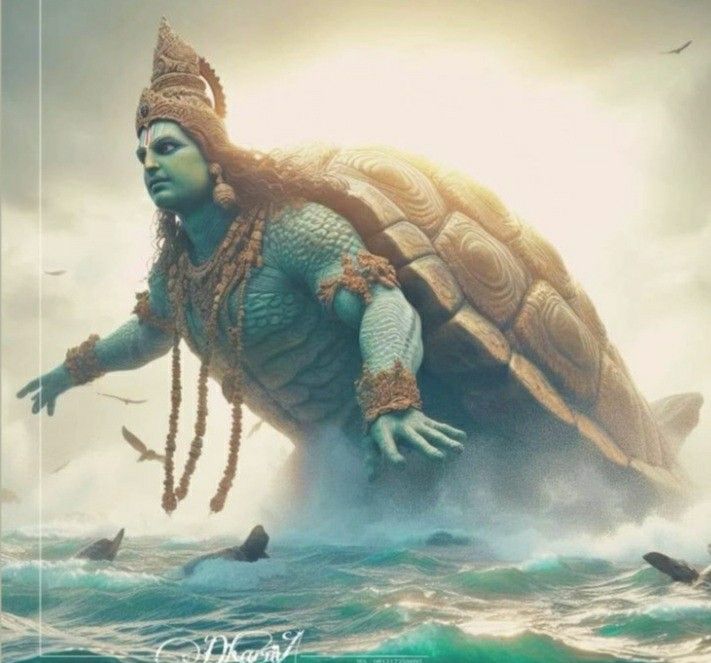
Title Thumbnail & Hero Image: source: www.pinterest.com, access date: Jun.5, 2025
7. Kūrma Purāṇa 1
First revision: Jun.5, 2025
Last change: May 3, 2026
Searched, gathered, rearranged, translated, and compiled by Apirak Kanchanakongkha.
1.
Page 7
1.
2.
Chapter 1(1)(1)
(Indradyumna’s salvation)
The Kūrma Purāṇa starts. This is a description of Indradyumna’s salvation. OUM. I prostrate myself before the immeasurable Viṣṇu, who assumed the form of Kūrma.1 I will narrate the Purāṇa recited by the origin of the universe. At the end of the sacrifice, the mahāṛṣis (महार्षि)2 in Naimiṣa (नैमिषारण्य) asked the unblemished Sūta, Romaharṣaṇa, about the sacred Purāṇa Saṃhitā.3 'O immensely intelligent Sūta! Illustrious one! You know about the Brahman. For the sake of the Itihāsa Purāṇa, you served Vyāsa properly. Since Dvaipayana's words delighted you and made all your body hair stand up, you became Romaharṣaṇa. In earlier times, the illustrious lord, Vyāsa, himself asked you to speak about Purāṇa Saṃhitā to the sages. At the time of Svayambhu’s long sacrifice, when the soma juice was extracted, to speak about the Saṃhitā, through his portion,
----------------
1. Kūrma means tortoise/turtle, and this is a reference to Viṣṇu’s Kūrma avatāra (incarnation).
2. Great sages.
3. Sūtas (सूत) were bards and raconteurs and also charioteers. Romaharṣaṇa (रोमहर्षण), equivalently Lomaharṣaṇa (लोमहर्षण), obtained his name because his recitals made the body hair of his listeners stand up. Alternatively, his body hair stood up. Saṃhitā (संहिता) means a collection. Here it refers to Kūrma Purāṇa.
1.
2.
Page 8
Puruṣottama manifested himself in your form1. Therefore, we are asking you about the excellent Kūrma Purāṇa. You are accomplished in the meanings of the Purāṇas, and you should tell us about it.' Hearing the words of the sages, Sūta, supreme among those who knew the Purāṇas, mentally prostrated himself before his guru, Satyavatī's son2 and spoke.
Romaharṣaṇa said, 'I prostrate myself before Hari,3 the origin of the universe, who assumed the form of Kūrma. I will narrate the divine account of the Purāṇa, which destroys sins. If he hears this, an evildoer will also proceed to the supreme destination. This account of the Purāṇa must never be spoken about to a non-believer.4 It must be narrated to the devout and the serene, dvijas5 who are devoted to dharma. One should speak about this account, narrated by Nārāyaṇa6 himself. The five signs of a Purāṇa are sarga, pratisarga, vaṃśa, manvantara, and aṃśānucarita. Brahmā Purāṇa is the first. Padma and Viṣṇu are the next. Then Śiva, Bhāgavata, Bhavishya, and Naradiya. After this, there are Mārkaṇḍeya, Agni, Brahmavaivarta, Linga, Varāha, Skanda, and Vāmana. Then, there are Kūrma, Matsya, Garuḍa and Vayaviya.
---------------
1. Svayambhu, the one who created himself, is Brahma. Puruṣottama, the excellent being, is Viṣṇu.
2. Vedavyāsa (वेदव्यास) was the son of Satyavatī (सत्यवती).
3. Viṣṇu (विष्णु) means हरि - Hari.
4. The text uses the word nāstika (नास्तिका), meaning non-believer, rather than atheist.
5. A dvija (द्विजा) is a person with a second birth, the second birth referring to the sacred thread ceremony. Sometimes the word dvija is used to refer to a Brāhmaṇa. However, more generally, it applies to the first three varṇas (वर्ण).
6. Viṣṇu.
1.
2.
Page 9
It is said that the eighteenth is known as Brahmāṇḍa.1
---------------
1. Because of what was said in the Introduction, nineteen Mahāpurāṇas are listed here.
1.
2.
3.
1.
2.
3.