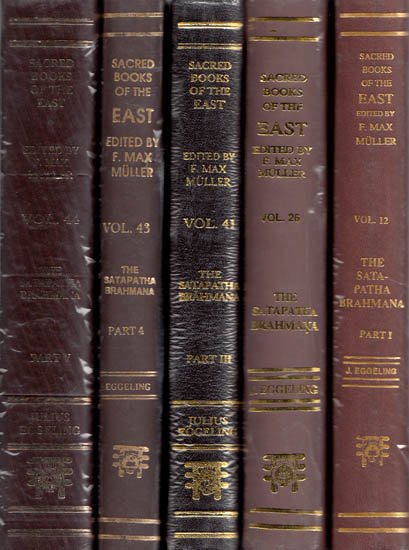
Title Thumbnail & Hero Image: Śatapatha Brāhmaṇa texts and translations, source: www.wisdomlib.org, access date: June 2, 2026.
Śatapatha Brāhmaṇa 1
First revision: Jun.2, 2026
Last change: Jun.2, 2026
Searched, gathered, rearranged, translated, and compiled by Apirak Kanchanakongkha.
1.
Page 1
The Śatapatha Brāhmaṇa (शतपथब्राह्मण, lit. 'Brāhmaṇa of one hundred paths', IAST: Śatapatha Brāhmaṇa, abbreviated to 'SB')[1] is a part of the Śukla Yajurveda. It is attributed to the Vedic sage Yajnavalkya. Described as the most complete, systematic, and important of the Brāhmaṇas (commentaries on the Vedas), it contains detailed explanations of Vedic sacrificial rituals, symbolism, and mythology.
Particularly in its description of sacrificial rituals (including construction of complex fire-altars).
The Śatapatha Brāhmaṇa is also considered significant in the development of Vaiṣṇavism as the origin of several Puranic legends and avatars of Viṣṇu. Notably, all of them (Matsya, Kūrma, Varāha, Nārasiṃha, and Vāmana) are listed as the first five avatars in the Daśāvatāra (दशावतार - the ten principal avatars of Viṣṇu).
There are two versions (recensions) available of this text. They are the Mādhyandina (माध्यंदिन - hymns of the Yajurveda) recension and the Kaṇva (कण्व) recension. This article focuses exclusively on the Mādhyandina version of the Śatapatha Brāhmaṇa.
- The Prajāpati of the Ṛg-Veda becomes the chief god and the creator of the world. Viśvakarman is identified with him. (viii. 2. 1. 10; viii. 2. 3. 13.)
- From being the cause of prayer, we in the Brāhmaṇas, the whole universe is regarded as produced from sacrifice; Brahman came to signify the creative principle of the world. [There are several passages where Brahman is used in this sense. “Verily in the beginning this universe was the Brahman; it created the gods” (Śat. Brāh., xi. 2. 3. 1. See also x. 6. 3. and Chān. Up., iii. 14.1)].
- The one ambition was to become immortal like the gods, who attained the status by performing sacrifices. (Śat. Brāh., iii. 4. 3; Aitareya Brāh., ii. I. I.).
- A rigid soul-deadening, commercialist creed based on a contractually motive took the place of the simple devout religion of the Vedas. [“He offers a sacrifice to the gods with the text: ‘Do thou give to me and I will give to thee; do thou bestow on me, and I will bestow on thee’” (Vājasaneyi Saṁhitā, iii. 50. See also Śat. Brāh., ii. 5. 3. 19).]
- “Verily, there are two kinds of gods; for the gods themselves assuredly are gods, and then the priests who have studied and teach Vedic lore are the human gods.” (Śat. Brāh., ii. 2. 2. 6; ii. 4. 3. 14.).
- “The sacrifice is like a ship sailing heaven-ward; if there be a sinful priest in it, that one priest would make it sink.” (Śat. Brāh., iv. 2. 5. 10.).
- “The Vedas issued like breath from the self-existent.” (Śatapatha Brāh., xi. 5. 81 ff.).
- “Verily, in the beginning, Prajāpati alone existed here. He thought with himself, how can I be propagated? He toiled and practiced austerities. Furthermore, he created living beings.” (Śat. Brāh., ii. 5. 1. 1-3).
- Godliness is of course the first duty. It does not consist in the mechanical performance of fixed ritual. It consists in praise and good works. Godliness means trying to be divine as much as possible. Truth-speaking is an essential part of godliness. It is a religious and moral duty. Agni is the lord of vows and Vāk and lord of speech. Both will be displeased if truthfulness is not observed. (“One law the gods observe-Truth.” Śat. Brāh., i. 1. 1. 4.: see also i. 1. 1. 5; iii. 3. 2. 2, and iii. 4. 2. 8, and ii, 2. 2. 19.).
- “Yonder world cannot be obtained by sacrificial gifts or by asceticism by the man who has not know this. That state belongs only to him who has this knowledge.” (Śat. Brāh., x. 5. 4. 15.).
- Adultery is condemned as a sin against the gods, especially Varuṇa. In all cases of evil-doing, confession is supposed to make the guilt less. (Śat. Brāh., ii. 5. 2. 20.).
- Mutual contempt increased. “These are the words of Kṣatriya,” is typical Brāhmin way of characterizing the words of an opponent.(Śat. Brāh., viii. 1. 4. 10.).
- The distinction between the path of the fathers and that of the devas is given. (Śat. Brāh.,viii. 1. 4. 10.).
- Rebirth on earth is sometimes looked upon as a blessing and not an evil to be escaped from. It is promised as a reward for knowing some divine mystery. (Śat. Brāh.,i. 5. 3.1 4.).
- “He who sacrifices thus obtains perpetual prosperity and renown and conquers for himself a union with the two gods Āditya and Agni and an abode in the same sphere." (Śat. Brāh.,xi. 6. 2. 5.).
- Particular sacrifices enable us to reach the spheres of particular gods. (Śat. Brāh.,ii. 6. 4. 8.).
- Death with birth for its cause seems to have become a thing to be avoided. Later, we find the conception that those who merely perform rites without knowledge are born again and repeatedly become the food of death. (Śat. Brāh., x. 4. 3. 10. See also x. 1. 4. 14; x. 2. 6. 19; x. 5. 1. 4; xi. 4. 3. 20.)