MENU
TH EN

2. Chāndogya Upaniṣad 1

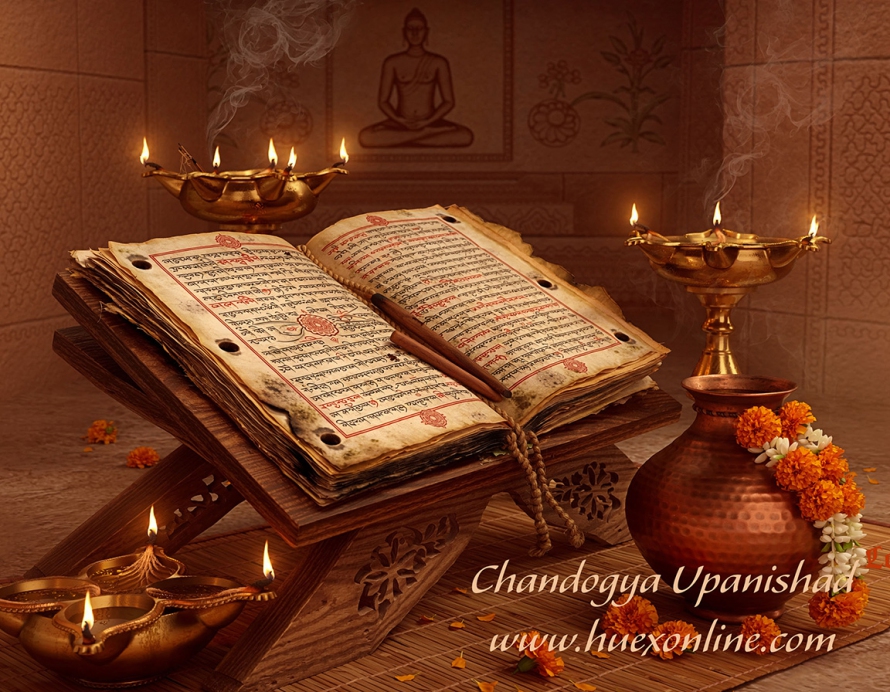
Title Thumbnail & Hero Image: Chāndogya Upaniṣad text, developed on May 26, 2026.

2. Chāndogya Upaniṣad 1

First revision: May 26, 2026
Last change: Sep.2, 2026
Searched, gathered, rearranged, translated, and compiled by Apirak Kanchanakongkha.
 
Page 1
  • Chāndogya Upaniṣad (छान्दोग्योपनिषद्) "Song and Sacrifice - Sacred Song" (Sāmaveda).
  • Tat Tvam Asi (तत् त्वम् असि) – literally translated as 'That Thou Art' ('That is you' or 'You are that') appears in Chāndogya Upaniṣad 6.8.7 of the Sama Veda, with tat in Ch.U. 6.8.7 referring to *sat, 'the Existent', and contextually understood as 'That's how [thus] you are', with tat in Ch.U. 6.12.3 referring to 'the very nature of all existence as permeated by [the finest essence]'.
  • “The true sacrifice is man; his consecration.… In his eating and drinking and in his pleasures, he keeps a holly festival, and in his laughter and feasting and marrying he sings hymns of praise. Self-discipline, generosity, straightforwardness, ahiṁsā and truth in speech, these are his payments, and the bath of purification when the sacrifice is over is death.” (Chān. Up., iii.).
  • Make every action, every feeling and every thought an offering to God. Let your life be one sacrament or yajña. Sometimes we are told that the sacrifices are necessary as preparations for the higher path. Nobody can tread the higher road without fulfilling the requirements of the lower. Sacrifices are necessary for the unenlightened, though they alone will not do. They give us admission to the world of the fathers, which after a temporary sojourn in the moon leads back to a new earthly existence. Ceremonialism is contrasted with spiritual worship. (Chān. Up., i. I, 10.).
  • There are occasions when the sacrificial and priestly religion strikes them as superficial, and then they give vent to all their irony. They describe a procession of dogs to march like a procession of the priests, each holding the tail of the other in front and saying, “Om! Let us eat. Om, let us drink… etc.”, (Chān. Up., i. 12, 4. 5.).
  • It is also recognized that the Vedic knowledge is much inferior to the true divine insight, (See Chāndogya. V. 3. 10,).

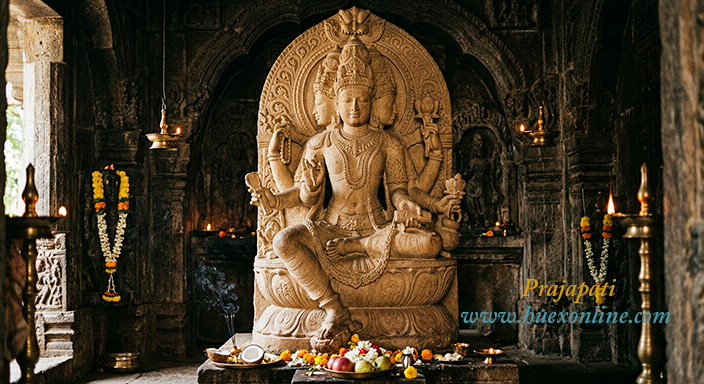
Prajāpati (प्रजापति), developed on Jul.20, 2026.
  • In a dialogue between the teacher Prajāpati and the pupil Indra, narrated in the Chāndogya Upaniṣads, Prajāpati opens the discussion by giving certain general characteristics which the true self should possess. “The self which is free from sin, free from old age, from death and grief, from hunger and thirst, which desires nothing, but what it ought to desire and imagines nothing, but what it ought to imagine, that it is which we must try to understand.” (viii. 7. 1.).
  • It is the universal self, which is immanent as well as transcendent. The whole universe lives and breathes in it. “The moon and the sun are its eyes, the four quarters of the sky its ears, the wind its breath.” (Chān., iii. 13. 7).
  • Self, It is the blazing light that burns in the deeps of personality, the universal ākāśa from which all creatures proceed (Chān., i. 91).
  • Self, the vital principle of creation. (Chān., i. 11. 5.).
  • Self, “There is not second outside it, no other distinct term.” (viii. 1.3).
  • In the Taittirīya Upaniṣad.1 In chapter iii, the son approaches the father with the request to teach him the nature of reality from which all things flow and to which all return. The son is sure that life belongs to a different order from matter, though prāṇa is the essence of the body. (vi. 2. 4.). (Prāṇa means breath. See R.V., i. 66. I; iii. 53. 21; x. 59. 6.).


humanexcellence.thailand@gmail.com