1.
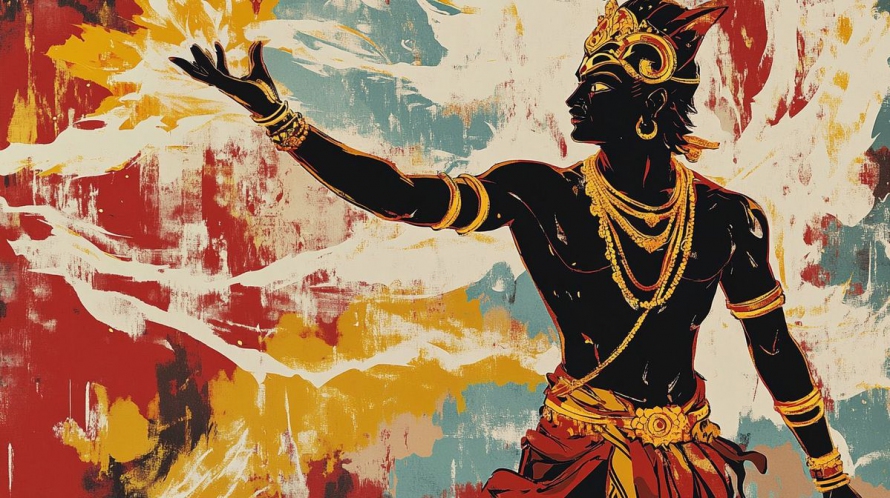
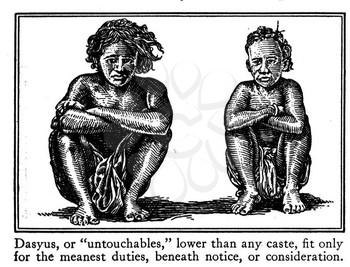
01. Dasyus (दस्यु - ทัสยุ) - The ancient dwellers of North Bharat. What we see in Ṛg-Veda is mostly a history of the Āryans from the period of their exodus from the plateau Kumbha till they reached the banks of the Yamunā. The plateau of Kuṃbha is Kabul. The Dasyus were the first people the Aryans had to confront with after passing the Indus. Ṛg-Veda bears testimony to the fact that the civilization of the Dasyus was far advanced than that of the Āryans. Śaṃbara, King of the Dasyus, was the ruler of hundred cities. All the cities were fortified with strong walls and fortresses, which are described as 'aśvamayī', 'āyasī', 'śatabhujī' etc. The greatest enemies of the Āryans were the 'Paṇis' of these cities. They were a particular class of people of these cities. In the 'Nirukta of Yāska' it is mentioned that paṇis were traders. Names of many of the Kings of the Dasyus occur in the Ṛg-Veda. Dhuni, Cumuri, Pipru, Varcas, Śaṃbara and such others are the most valiant and mighty among them. The most important of the several tribes of the Dasyus were the Śimyus, the Kīkaṭas, Śigrus and the Yakṣus. They are mentioned as the Anāsas in the Ṛg-Veda. (Anāsas—without nose). Perhaps their nose was flat; more over they are stated as having dark complexion. So it may be assumed that the Dasyus were Dravidians. They talked a primitive language, and they despised sacrificial religion. They did not worship Gods like Indra and others. Furthermore, they possibly worshipped the Phallus, Śiva, Devi and the like.
1.
2.
119
the broad current of popular religion and superstition has infiltrated itself through numberless channels into the higher religion that is presented by the Brāhmin priests, and it may be presumed that the priests were neither able to cleanse their own religious beliefs from the mass of folk with which it was surrounded, nor is it at all likely that they found it in their interest to do so."1 Such are the revenges which the weak of the world have on the strong. The explanation of the miscellaneous character of the Hindu religion, which embraces all the intermediate regions of thought and belief from the wandering fancies of savage superstitions to the highest insight of daring thought, is here. From the beginning, the Aryan religion was expansive, self-developing, and tolerant. It went on accommodating itself to the new forces it met with in its growth. In this can be discerned a refined sense of true humility and sympathetic understanding. The Indian refused to ignore the lower religions and fight them out of existence. He did not possess the pride of the fanatic that his was the one true religion. If a god satisfies the human mind in its own way, it is a form of truth. None can lay hold upon the whole of truth. It can be won only by degrees, partially and provisionally. But they forgot that intolerance was sometimes a virtue. There is such a thing as Gresham's law in religious matters also. When the Aryan and the non-Aryan religions, one refined and the other vulgar, the one good and the other base, met, there was the tendency for the bad to beat the good out of circulation.
II
THEOLOGY
THE religion of the Atharva-Veda is that of the primitive man, to whom the world is full of shapeless ghosts and spirits of death. When he realises his helplessness against the natural forces, the precariousness of his own existence so constantly subject to death, he makes death and disease, failure of monsoon and earthquake, the playground of his fancy.
---------------
1. S.B.E., vol. xliii.
1.
2.
120
The world becomes crowned with goblins and gods, and the catastrophes of the world are traced to dissatisfied spirits. When a man falls ill, the magician and not the physician is sent for, and he employs spells to entice the spirit away from the patient.1 The terrific powers could only be appeased by bloody sacrifices, human and animal. The fear of death gave a loose rein to superstition. Madame Ragozin writes: "We have here, as though in opposition to the bright, cheerful pantheon of beneficent deities, so trustingly and gratefully addressed by the Ṛṣis of the Ṛg-Veda, a weird repulsive world of darkly scowling demons, inspiring abject fear such as never sprang from Aryan fancy."2 The religion of the Atharva-Veda is an amalgam of Aryan and non-Aryan ideals. The distinction between the spirit of the Ṛg-Veda and that of the Atharva-Veda is thus described by Whitney: “In the Ṛg-Veda, the gods are approached with reverential awe, indeed, but with love and confidence also; a worship is paid them which exalts the offerer of it; the demons embraced under the general name Rākṣas are objects of horror, whom the gods ward off and destroy; the divinities of the Atharva-Veda are regarded rather with a kind of cringing fear, as powers whose wrath is to be deprecated and whose favor curried; it knows a whole host of imps and hobgoblins, in ranks and classes, and addresses itself to them directly, offering them homage to induce them to abstain from doing harm. The mantra, prayer, which in the older Veda is the instrument of devotion, is here rather the tool of superstition; it wrings from the unwilling hands of the gods the favors which of old their goodwill to men induced them to grant, or by simple magical power obtains the fulfillment of the utterer’s wishes. The most prominent feature of the Atharva is the multitude of incantations which it contains. These are pronounced either by the person who is himself to be benefited or more often by the sorcerer for him, and are directed to the procuring of the greatest variety of desirable ends….
---------------
1. If such a view persisted, it was because it had an element of truth. Modern psychology has come to recognize the power of suggestion as a remedy for the ills of the flesh, specially nervous disorders.
2. Vedic India, pp. 117-118.
.jpg) Зинаида Алексеевна Рагозина - Zénaïde Alexeïevna Ragozin (1834-1924), A Russian-American author,
Зинаида Алексеевна Рагозина - Zénaïde Alexeïevna Ragozin (1834-1924), A Russian-American author,
source: en.wikipedia.org, access date: Apr.10, 2026.
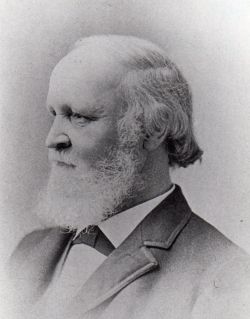
William Dwight Whitney (Feb.9, 1827-Jun.7, 1894), source: dbcs.rutgers.edu, access date: Apr.11, 2026.1.
121
There are hymns, too, in which a single rite or ceremony is taken up and exalted, somewhat in the same strain as the Soma in the Pāvamāna hymns of the Ṛg; others of a speculative mystical character are not wanting; yet their number is not so great as might naturally be expected, considering the development which the Hindu religion received in the periods following after that of the primitive Veda. It seems in the main that the Atharva is a popular rather than a priestly religion; that, in making the transition from the Vedic to modern times, it forms an intermediate step, rather to the gross idolatries and superstitions of the ignorant mass than to the sublimated pantheism of the Brāhmins.”1 A religion of magic, with its childish reliance on sorcery and witchcraft, takes the place of the purer Vedic religion; the medicine man who knows how to scatter the spirits and control them holds the supreme position. We hear of great ascetics who obtain the mastery of nature by tapas. They are reduced by the mortification of the body. Man can participate in divine power through the hidden force of magic. The professors of magic and witchcraft were accepted by the Vedic seers, and their calling was dignified, with the result that magic and mysticism soon became confused. We find people sitting in the midst of five fires, standing on one leg, holding an arm above the head, all for the purpose of commanding the forces of nature and subduing the gods to their will.
While the Atharva-Veda gives us an idea of demonology prevalent among the superstitious tribes of India, it is more advanced in some parts than the Ṛg-Veda and has certain elements in common with the Upaniṣads and the Brāhmaṇas. We have the worship of the Kāla, time; Kāma, or love; Skambha, or support. The greatest of them all is Skambha. He is the ultimate principle, called indiscriminately Prapāpati, Puruṣa, and Brahman. He includes all space and time, gods and Vedas, and the moral power.2 Rudra is the lord of animals and forms the point of linkage between the Vedic religion and the later Śiva worship.
---------------
1. P.A.O.S., iii. pp. 307-8. (Proceedings of the American Oriental Society – www.jstor.org).
2. See x. 7. 7. 13, 17.
1.
2.
122
Śiva in the Ṛg-Veda means only auspicious but is not the name of a god; the Rudra in the Ṛg-Veda is a malignant cattle-destroying deity.1 Here he is, the lord of all cattle, Paśupati01. Prāṇa is hailed as a life-giving principle of nature.2 The doctrine of vital forces, which figures so much in later Indian metaphysics, is first mentioned here, and may possibly be a development of the principle of air of the Ṛg-Veda. While the deities of the Ṛg-Veda were of both sexes, the males were more prominent. In the Atharva-Veda, the emphasis is shifted. No wonder in Tāntric philosophies sex becomes the basis. The sacredness of the cow is recognized, and Brahma-loka is mentioned in the Atharva-Veda.3 Hell is known by its proper name. Naraka, with all its horror and tortures,4 is fairly familiar.
Even the magical portion of the Atharva-Veda shows Aryan influence. If magic has to be accepted, the next best thing is to refine it. Bad magic is condemned and good magic encouraged. Many charms make for harmony in family and village life. The barbarous and bloody sacrifices which still persist in unaryanized parts of India are condemned. The old title of the Atharva-Veda, “Atharvāṅgirasaḥ,” shows that it comprised two distinct strata: one of Atharvan and the other of Aṅgiras. The former refers to auspicious practices used for healing purposes.5 The hostile practices belong to the Aṅgirases. The first is medicine, and the second is witchcraft, and the two are mixed up.
The Atharva-Veda, the result of so much compromise, seemed to have had a good deal of trouble in obtaining recognition as a Veda.6 It was regarded with contempt, since its central feature was sorcery. It contributed to the growth of a pessimistic outlook in India. Men cannot believe in the devil and the tempter and yet retain joy in life. To see demons close at hand is to shudder at life.
---------------
1. R.V., iv. 3. 6; i. 114. 10.
2. A.V., x. 7.
3. xix. 71. I.
4. xii. 4. 36.
5. Bheṣajani, A.V., xi. 6. 14.
6. In many of the early scriptures, we have only the three Vedas mentioned, R.V., x. 90. 9; v. 7. I; Tait. Up., ii. 2-2. The canonical works of the Buddhists do not mention the Atharva-Veda. At a later date, the Atharva-Veda also acquired the status of a Veda.
Notes & Narratives:
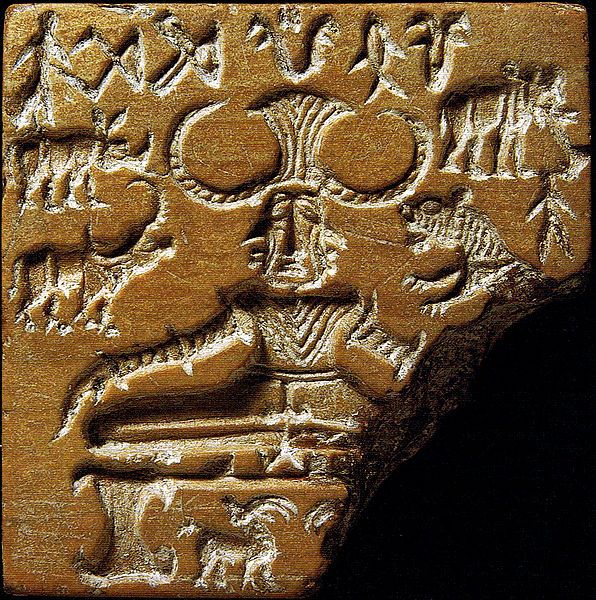 Paśupati-Śiva Seal, Steatite, Mohenjo-Daro, c. 2700-2000 B.C.E, Paśupati Seal
The Paśupati seal depicts a yogi seated crossed-legged wearing a headgear. In Mesopotamia, the wearing of a horned headdress by a ruler was believed to impart divinity to him, picture from: www.pinterest.com, content from: www.wisdomlib.org, access date: Apr.28, 2026.
01. Paśupati (पशुपति) - a form of Śiva.—The Ṛg-Veda describes Rudra as Paśupati in a more or less general way although he is more closely connected with cattle but the Atharva-Veda mentions cows, horses, goats, sheep and dogs, also deer, ducks, birds and vultures, dolphins, pythons and fish. The Vājasaneyīsaṃhitā connects Rudra with snakes and monsters. In the Śatapatha Brāhmaṇa (2.6.2.2) the mole (ākhu) is the animal of Śiva. Later the mole is specifically allotted to Gaṇeśa, Śivas Puranic and post-Puranic son. In the Yajur-Veda, Atharva-Veda, Śatapatha Brāhmaṇa and Āśvalāyana-Gṛhyasūtra (4.8.19), Paśupati is a form of Rudra.
1.
2.
123
In fairness to the Atharva-Veda, it must be recognized that it helped to prepare the way for the scientific development in India.
III
THE YAJUR-VEDA AND THE BRĀHMAṆAS
In the history of thought creative and critical epochs succeed each other. Periods of rich and glowing faith are followed by those of aridity and artificiality. When we pass from the Ṛg-Veda to the Yajur and the Sāma Vedas and the Brāhmaṇas, we feel a change in the atmosphere. The freshness and simplicity of the former give place to the coldness and artificiality of the latter. The spirit of religion is in the background, while its forms assume great importance. The need for prayer-books is felt. Liturgy is developed. The Hymns are taken out of the Ṛg-Veda and arranged to suit sacrificial necessities. The priest becomes the lord. The Yajur-Veda gives the special formulas to be uttered when the altar is to be erected, etc., and the Sāman describes the songs to be chanted at the sacrifice. These Vedas may he discussed along with the Brāhmaṇas since they all describe the sacrificial liturgy. The religion of the Yajur-Veda is a mechanical sacerdotalism. A crowd of priests conducts a vast and complicated system of external ceremonies to which symbolical significance is attached and to the smallest minutiæ of which the greatest weight is given. The truly religious spirit could not survive in the stifling atmosphere of ritual and sacrifice. The religious feeling of the adoration of the ideal and the consciousness of guilt is lacking. Every prayer is coupled with a particular rite and aims at securing some material advantage. The formulas of the Yajur-Veda are full of dreary repetitions of petty requests for the goods of life. We cannot draw a sharp distinction between the age of the hymns of the Ṛg-Veda and the other Vedas and the Brāhmaṇas, since the tendencies which became predominant in the latter were also found in the hymns of the Ṛg-Veda. We can say with some degree of certainty that the mass of the hymns of the Ṛg-Veda belongs to an age earlier than that of the Brāhmaṇas.
1.
2.
124
IV
THEOLOGY
The Brāhmaṇas, which form the second part of the Vedas, are the ritual textbooks intended to guide the priests through the complicated details of sacrificial rites. The chief of them is the Aitareya and the Śatapatha. Differences of detail in interpretation led to the formation of several schools of the Brāhmaṇas. The period is marked by important changes in the religious evolution, which have permanently affected its future history. The emphasis on sacrifice, the observance of caste and the āśramas, the eternity of the Veda, the supremacy of the priest, all belong to this age.
We may begin by nothing additions made to the Vedic pantheon during the period. Viṣṇu rose in importance in the Yajur-Veda. The Śatapatha Brāhmaṇa makes him the personification of sacrifice.1 The name Nārāyaṇa also occurs in it, though it is only in the Taittirīya Āraṇyaka that two Nārāyaṇa and Viṣṇu are brought into relation. Śiva makes his appearance, and is refered to under different names in the Kauṣītaki Brāhmaṇa.2 Rudra has now a benignant form and is called Giriśa.3 The Prajāpati of the Ṛg-Veda becomes the chief god and the creator of the world. Viśvakarman is identified with him.4 Monotheism is inculcated. Agni is very important. Brāhmaṇaspati, the lord of prayer, becomes the leader of hymns and the organizer of rites. Brahman in the Ṛg-Veda means a hymn or a prayer addresses to God. From the subjective force which helped the seer to compose a prayer, it came to mean the object prayed for. From being the cause of prayer, we in the Brāhmaṇas, the whole universe is regarded as produced from sacrifice; Brahman came to signify the creative principle of the world.5
---------------
1. v.2. 3. 6; v. 4-5. 1; xii. 4.1. 4; xiv. 1. 1. 6 and 15.
2. vi. 1-9.
3. See Tait. Saṁhita, iv. 5. i; Vajasaneyi Saṁhitā, ix.
4. Śat. Brāh., viii. 2. 1. 10; viii. 2. 3. 13.
5. There are several passages where Brahman is used in this sense. “Verily in the beginning this universe was the Brahman; it created the gods” (Śat. Brāh., xi. 2. 3. 1. See also x. 6. 3. and Chān. Up., iii. 14.1).
1.
2.
125
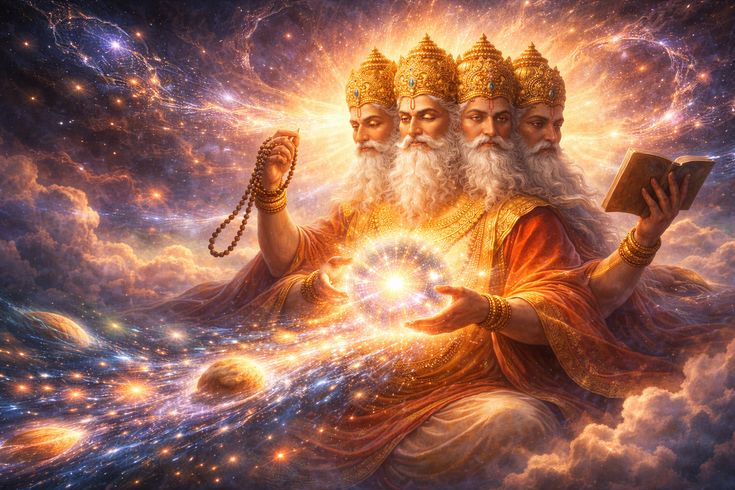 Lord Brahma, source: www.pinterest.com, access date: May 10, 2026.
The religion of the Brāhmaṇas was purely formal. The poetic fire and the heartiness of the Vedic hymns are no more. Prayer comes to mean the muttering of mantras, or the utterance of sacred formulas. Loud petitions were thought necessary to rouse God to action. The words became artificial sounds with occult powers. Nobody could understand the mystery of it all, except the priest who claimed for himself the dignity of a god on earth. The one ambition was to become immortal like the gods, who attained the status by performing sacrifices.1 All are subjected to the influence of sacrifices. Without them, the sun would not rise. We can depose Indra from his throne in heaven if perform a hundred horse-sacrifices. The sacrifices please the gods and profit men. Through them, the gods become the friends of men. The sacrifices were made as a rule for gaining earthly profits and not heavenly bliss. A rigid soul-deadening, commercialist creed based on a contractually motive took the place of the simple devout religion of the Vedas.2 The sacrifices of the Vedic hymns were a superfluous appendage of prayers indicative of true religion, but now they occupy the central place. Every act done, every syllable uttered at the ceremony is important. The religion of the Brāhmaṇas became loaded with symbolic subtleties and was ultimately lost in a soulless mechanism of idle rites and pedantries of formalism.
The increasing dominance of the idea of sacrifice helped to exalt the position of the priests. The ṛṣi of the Vedic hymns, the inspired singer of truth, becomes now the possessor of a revealed scripture, the repeater of a magic formula. The simple occupational division of the Aryans into the three classes assumes during the period a hereditary character. The highly elaborate nature of the sacrificial ceremonial demands special training for the priestly office. The patriarchal head of the family could no more conduct the complex and minute system of the sacrificial ceremony. Priesthood became a profession and a hereditary one.
---------------
1. Śat. Brāh., iii. 4. 3; Aitareya Brāh., ii. I. I.
2. “He offers a sacrifice to the gods with the text: ‘Do thou give to me and I will give to thee; do thou bestow on me, and I will bestow on thee’” (Vājasaneyi Saṁhitā, iii. 50. See also Śat. Brāh., ii. 5. 3. 19).
1.
2.
126
The priest who possessed the Vedic lore became the accredited intermediaries between gods and men and the dispensers of the divine grace. The yajamāna, or the man for whom rites is performed, stands aside. He is a passive agent supplying men, money and munitions; the priest does the rest for him. Selfishness, with its longing for power, prestige, and enjoyment, pressed its way in and dimmed the luster of the original ideal. Attempts were made to mislead the people about the value of the offerings. A monopoly of functions and offices was secured. The ground was consolidated by the development of an extravagant symbolism. Language was used as if it was given to us to hide our thoughts. Only the priest could know the hidden meaning of things. No wonder the priest claimed for himself a divine divinity. “Verily, there are two kinds of gods; for the gods themselves assuredly are gods, and then the priests who have studied and teach Vedic lore are the human gods.”1
We have here and there priests who seriously declare that they can bring about the death of him who actively employs them, though they have the moral sense to know that such an act is forbidden.2 Another circumstance which further strengthened the priestly class was the necessity for the preservation of the Vedas which the Aryans brought with them, and round which, as we shall see in the sequel, a halo of sanctity grew. The Brāhmin class was entrusted with their preservation. If the Vedas are to survive, the Brāhmin must be true to his vocation. He imposed on himself accordingly severe conditions. “A Brāhmin unlearned in holy writ is extinguished in an instant like dry grass on fire.”3 A Brāhmin should shun worldly honor as he should shun poison. As a Brāhmacārin or student, he must control his passions, wait on his preceptor, and beg for his food; as a householder, he must avoid wealth, speak the truth, lead a virtuous life, and keep himself pure, faithful to the charge committed to their keeping. We need not speak of the wonderful way in which they have preserved the Vedic tradition against all the dangerous accidents of history.
---------------
1. Śat. Brāh., ii. 2. 2. 6; ii. 4. 3. 14.
2. Tait. Saṁhitā, i. 6. 10. 4, and Ait. Brāh., ii. 21. 2.
3. Manu.
1.
2.
127
Even to-day we can meet in the streets of Indian cities these walking treasure-houses of Vedic learning. The rigid barriers of the later age are to be traced to historical accidents. In the age of the Brāhmaṇas, there was not much material distinction among the twice-born Aryans. They could all be educated in Vedic knowledge.1 “The sacrifice is like a ship sailing heaven-ward; if there be a sinful priest in it, that one priest would make it sink.”2 So morality was not dismissed as altogether irrelevant. The Brāhmin priests were neither wicked nor stupid. They had their own ideas of duty and righteousness, which they tried to preach to others. They were honest, upright men who obeyed the rules, observed ceremonies, and defended dogmas to the best of their ability. They had a sense of their calling and fulfilled it with zest and reverence. They framed elaborate codes of laws expressing their great love of learning and humanity. If they erred, it was because they were themselves fettered by a tradition. They were sincere souls whatever their hallucinations. They felt no shadow of doubt about the truth of their own orthodoxy. Their thought was paralyzed by the conventions of times. Yet no one would say that their pride in their own culture and civilization was illegitimate at a time when the world around was steeped in barbarism, and a thousand rude and tyrannous elements provoked them into this feeling.
In the nature of things, a professional priesthood is always demoralizing. But there is no reason to think that the Brāhmin of India was more pompous and hypocritical than any other. As against the possible degeneration, protests were uttered by the true Brāhmins, filled with the serene calm and the simple grandeur of the prophet soul even in that age. They raised a revolt against the ostentation and hypocrisy of the selfish priest and blushed at the corruption of a great ideal.
---------------
1. Manu says: “A twice-born man, a Brāhmin, Kṣatriya or Vaiśya, unlearned in the Vedas, soon falls, even while living, to a condition of Śūdra.” In the Mahābhārata, we read: “The order of Vānaprasthas, of sages who dwell in forests and live on fruits, roots, and air, is prescribed for the three twice-born classes; the order of householders is prescribed for all.”
2. Śat. Brāh., iv. 2. 5. 10.
1.
2.
128
In any estimate of the priesthood, it is to be remembered that the Brāhmins take into account the duties to be performed by the householder. There were other stages of the Vānaprastha and the Sannyāsa when ritual is not binding at all. The Brāhmanical rule would not have lasted if it had been felt as tyrannical or coercive. It commanded the confidence of the thinking, since it only insisted that everybody should fulfill his social duties.
In later philosophy, we hear much of what is called the authoritativeness of the Vedas or Śabdapramāṇa. The darśana’s or systems of philosophy are distinguished into orthodox or heterodox according as they accept or repudiate the authority of the Veda. The Veda is looked upon as a divine revelation. Though the Hindu apologists of a later day offer ingenious interpretations in support of Vedic authority, still so far as the Vedic seers are concerned, they mean by it the highest truth revealed to a pure mind. “Blessed are the pure in heart for they shall see God.” The ṛṣi of the Vedic hymns calls himself not so much the composer of the hymns as the seer of them.1 It is seeing with mind’s eye or intuitive seeing. The ṛṣi has his eyes unblinded by the fumes of passion, and so can see the truth which is not evident to the senses. He only transmits the truth which he sees but does not make.2 The Veda is called “Śruti,” or the rhythm of the infinite heard by the soul. The words dṛṣi and śruti, which are the Vedic expressions, point out how the Vedic knowledge is not a matter of logical demonstration, but an intuitive insight. The poet’s soul hears or has revealed to it the truth in its inspired condition, when the mind is lifted above the narrow plane of the discursive consciousness. According to the Vedic seers the contents of the hymns are inspired and revelatory only in this sense. It is not their intention to suggest anything miraculous or supernatural. They even speak of the hymns as their own compositions or creations. They compare their work as poets with that of the carpenter,
---------------
1. The word “Veda” is derived from the Aryan root “vid,” which means “seeing.” Cf. Vision (from Latin video); Ideas (from Greek eidos), wit.
2. “All artistic creation,” says Beethoven, “comes from God, and relates to man only in so far as it witnesses to the action of the divine within him.”
1.
2.
129
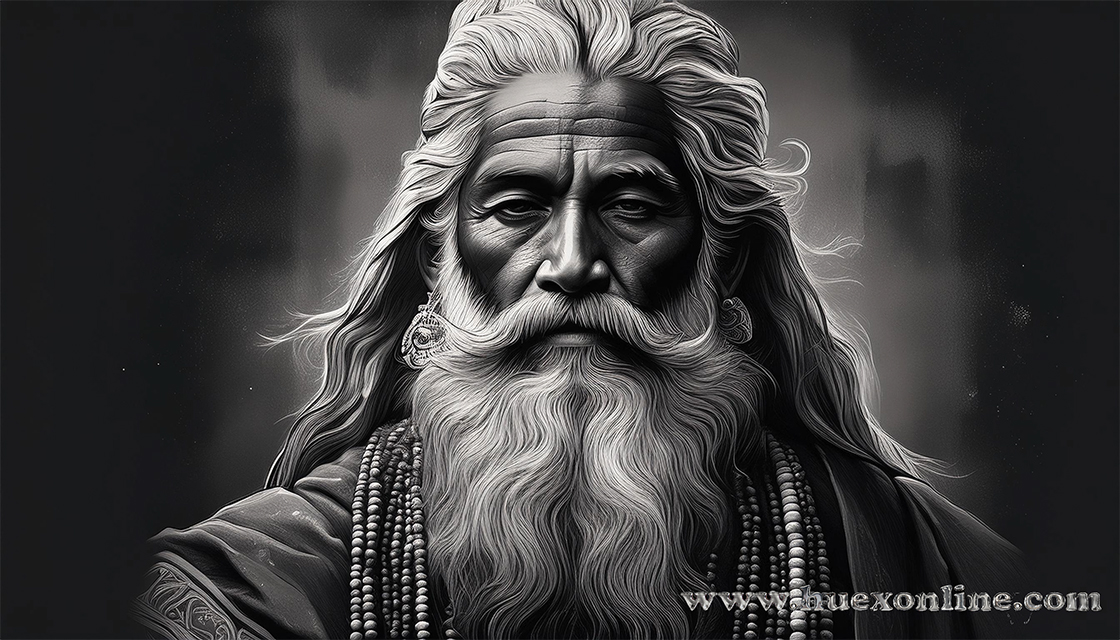
Great Brahmana-Hindu Sage was developed on July 31, 2024.
1.
the weaver, the rower,1 and give natural explanations of it. The hymns are shaped by the feelings of the human heart.2 Sometimes they say they found the hymns.3 They also attribute them to the exaltation consequent on the drink of Soma.4 In a very humble spirit they hold the hymns to be God-given.5 The idea of inspiration is not yet transformed into that of an infallible revelation.
When we come to the Brāhmaṇas, we reach an age when the divine authority of the Vedas is accepted as a fact.6 The claim to divine revelation, and therefore eternal validity, is set up in this period. Its origin is easily intelligible. Writing was then unknown. There were neither printer not publishers. The contents of the Vedas were transmitted by oral repetition through a succession of teachers. To ensure respect, some sanctity was attached to the Vedas. In the Ṛg-Veda Vāk, or speech, was a goddess. And now they said from Vāk the Vedas issued forth. Vāk is the mother of the Vedas.7 In the Atharva-Veda the mantra is said to possess magical power. “The Vedas issued like breath from the self-existent.”8 The Vedas came to be regarded as divine revelation, communicated to the ṛṣis, who were inspired men. Śabda, articulate sound, is considered eternal. The obvious effect of this view of the Vedas is that philosophy becomes scholastic. When the spoken word, real and alive, gets fixed in a rigid formula, its spirit expires. The authoritativeness of the Veda formulated so early in the history of Indian thought has affected the whole course of subsequent evolution.
---------------
1. See Muir, Sanskrit Texts, vol. iii.
2. R.V., i. 117. 2; ii. 35. 2.
3. x. 67. I.
4. vi. 47. 3.
5. i. 37. 4; iii. 18. 3. In the second chapter of Muir’s Sanskrit Texts (vol. iii. pp. 217-86) we have a collection of passages which clearly show that “though some at least of the ṛṣis appear to have imagined themselves to be inspired by the gods in the expression of their religious emotion and ideas, they at the same time regarded the hymns as their own compositions, or as (presumably) the compositions of their forefathers, distinguishing between them as new and old and describing their own authorship in terms which could only have been dictated by a consciousness of its reality.”
6. See Aitareya Brāhmaṇa, vii. 9.
7. Vedānām mātā. Tait. Brāh., ii. 8. 8. 5. Compare the opening of the St. John’s Gospel: “In the beginning was the Word.”
8. Śatapatha Brāh., xi. 5. 81 ff., and also the Puruṣa Sūkta.
1.
2.
130
In later philosophy, the tendency developed to interpret the unsystematic and not always consistent texts of the earlier age in line with set opinions. When once the tradition is regarded as sacred and infallible, it must be represented as expressing or implying what is considered to be the truth. This accounts for the fact that the same texts are adduced in support of varying tenets and principles, mutually contradictory and inconsistent. If fidelity to dogma and diversity of view should live together, it is possible only through absolute freedom of interpretation, and it is here that the Indian philosophers show their ingenuity. It is surprising that, in spite of the tradition, Indian thought kept itself singularly free for a long time from dogmatic philosophizing. The Indian thinkers first arrive at a system of consistent doctrine and then look about for texts of an earlier age to support their position. They either force them into such support their position. They either force them into such support or ingeniously explain them away. There has been one good effect of this Vedic tradition. It has helped to keep philosophy real and living. Instead of indulging in empty disputations and talking metaphysics which has no bearing on life, the Indian thinkers had a fixed foundation to go upon, the religious insight of the highest seers as expressed in the Vedas. It gave them a hold on the central facts of life, and no philosophy could afford to discard it.
1.
2.
V
THEORIES OF CREATION
1.
With regard to the theories of creation, though the lead of the Ṛg-Veda is generally followed, there are some fanciful accounts also mentioned. After the Ṛg-Veda, the Taittirīya Brāhmaṇa says, “formerly nothing existed, neither heaven nor atmosphere nor earth.” Desire is the seed of existence. Prajāpati desires offspring and creates. “Verily, in the beginning, Prajāpati alone existed here. He thought with himself, how can I be propagated? He toiled and practiced austerities. He created living beings.”1
---------------
1. Śat. Brāh., ii. 5. 1. 1-3.
1.
2.
131
1.
VI
ETHICS
1.
In fairness to the religion of the Brāhmaṇas, it is to be said that we find frequent traces in them of high moral sense and exalted sentiment. The conception of man’s duty first arises here. Man is said to owe some debts or duties to gods, men, and animals. The duties are distinguished into (1) those to the gods, (2) those to seers, (3) those to manes, (4) those to men, (5) and those to the lower creation. He who discharges them all is the good man. No man can touch his daily meal without offering parts of it to gods, fathers, men, and animals, and saying his daily prayers. This is the way to live in harmony with the world around him. Life is a round of duties and responsibilities. The conception is certainly high and noble whatever the actual filling of the ideal may be. Unselfishness can be practiced in all our acts. In the Śatapatha Brāhmaṇa, the sacrifice of all things, sarvamedha, is taught as a means to the attainment of spiritual freedom.1 Godliness is of course the first duty. It does not consist in the mechanical performance of fixed ritual. It consists in praise and good works. Godliness means trying to be divine as much as possible. Truth-speaking is an essential part of godliness. It is a religious and moral duty. Agni is the lord of vows and Vāk and lord of speech. Both will be displeased if truthfulness is not observed.2 We notice already the symbolical interpretation of sacrifices. There are passages which point to the essential futility of works. “Yonder world cannot be obtained by sacrificial gifts or by asceticism by the man who has not know this. That state belongs only to him who has this knowledge.”3 Adultery is condemned as a sin against the gods, especially Varuṇa. In all cases of evil-doing, confession is supposed to make the guilt less.4 Asceticism is also held up as a worthy ideal,
---------------
1. xiii. 7. 1. 1.
2. “One law the gods observe-Truth.” Śat. Brāh., i. 1. 1. 4.: see also i. 1. 1. 5; iii. 3. 2. 2, and iii. 4. 2. 8, and ii, 2. 2. 19.
3. Śat. Brāh., x. 5. 4. 15.
4. Śat. Brāh., ii. 5. 2. 20.
1.
2.
132
for the gods are supposed to have obtained divine rank by austerity. 1
The āśrama dharma was introduced or more correctly formulated in this age.2 The Vedic Aryan’s life has the four stages or āśramas, as they are called, of (1) Brahmacārin or student, when he is expected to study one or more Vedas; (2) the Gṛhastha or the householder, when he has to fulfill the duties mentioned in the scriptures, social and sacrificial; (3) the Vānaprastha or the hermit, when the devotee spends his time in fasting and penance; and (4) the Sannyāsin or the ascetic, who has no fixed abode. He is without any possessions or property and longs for union with God. The four parts of the Veda, the hymns, the Brāhmaṇas, the Āraṇyakas, and the Upaniṣads answer to the four stages of the Vedic Aryan’s life.3 Beneath the formalism of ceremonial worship there was at work a spirit of true religion and morality, from which the heart of man obtained satisfaction. It is this ethical basis which has helped the Brāhmanical religion with all its weaknesses to endure so long. Side by side with its insistence on the outer, there was also the emphasis on inner purity. Truth, godliness, honor to parents, kindness to animals, love of man, abstinence from theft, murder and adultery, were inculcated as the essentials of a good life.
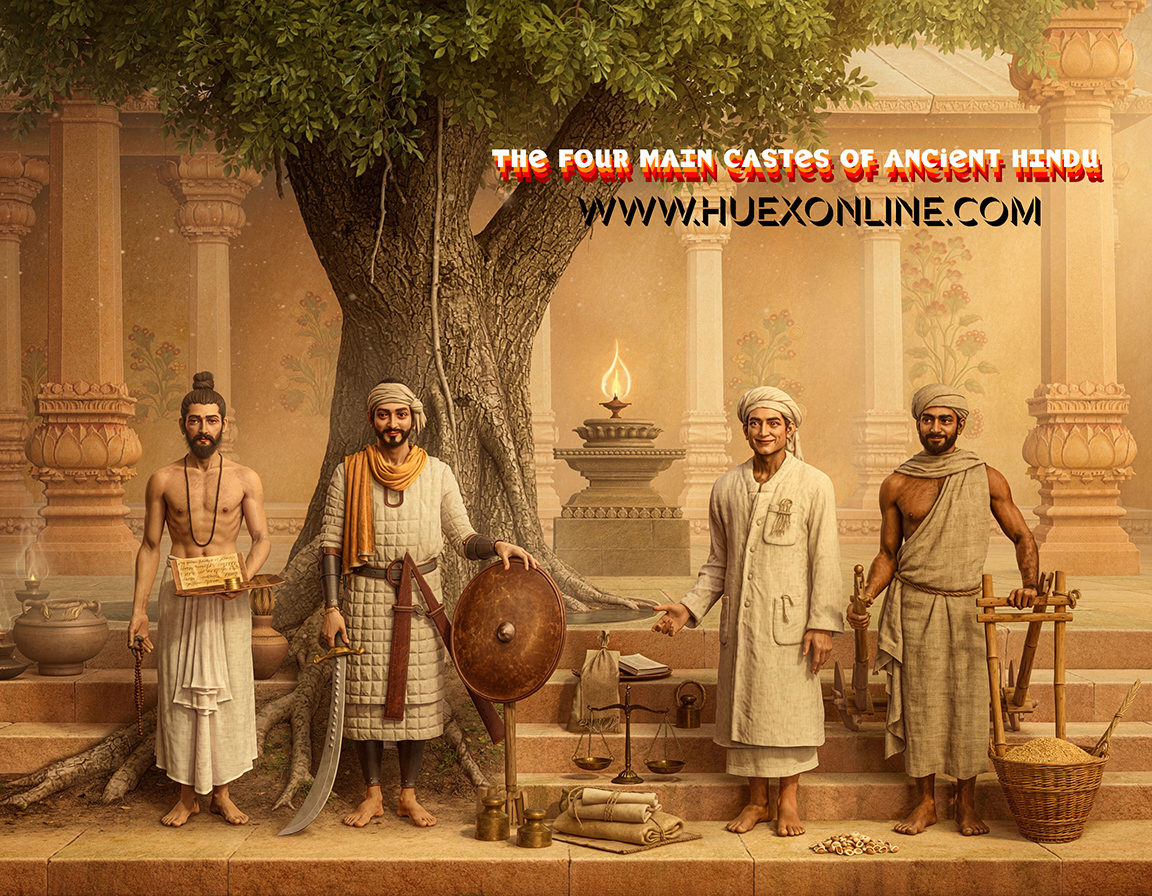
The Four Main Castes of Ancient Hindu, developed on Apr.16, 2026.
1.
The institution of caste is not the invention of an unscrupulous priesthood, but a natural evolution conditioned by the times. It was consolidated in the period of the Brāhmaṇas. The Puruṣa Sūkta, though a part of the Ṛg-Veda, really belongs to the age of the Brāhmaṇas. It clear that there were then inter-marriages between the Aryans and Dasyus.4 To avoid too much confusion of blood, an appeal was made to the pride of the Aryans. What was originally a social institution becoming a religious one. A divine sanction was given to it, and the laws of caste became immutable.
---------------
1. Brāh., iii. 12. 3.
2. The word āśrama, derived from a root meaning “to toil,” shows that the Indians realized that suffering was incidental to all progress.
3. The account of these stages varies with the authorities. See bṛh., Up., iii. 5. 1; Āpastamba Sūtras, ii. 9.21. 1; Gautama Sūtras, iii. 2; Bodhāyana, ii. 6.11. 12; Manu., v. 137. Vi.87; Vasiṣṭha, vii. 2.
4. A.V., v. 17.8.
1.
2.
133
The flexibility of the original class system gave way to the rigidity of the caste. In the early Vedic period, the priest formed a separate profession, but not a separate caste. Any Aryan could become a priest, and the priestly class was not necessarily superior to the warrior or the trading classes. Sometimes they were even treated with contempt.1 But now the exclusiveness born of pride becomes the basis of caste. It tended to suppress free thought and retarded the progress of speculation. The moral standard sank. The individual who transgressed the rules of caste was a rebel and an outcaste. The Śūdras were excluded from the highest religion. Mutual contempt increased. “These are the words of Kṣatriya,” is typical Brāhmin way of characterizing the words of an opponent.2
1.
2.
VII
ESCHATOLOGY
1.
In the Brāhmaṇas we do not find any one view about the future life. The distinction between the path of the fathers and that of the devas is given.3 Rebirth on earth is sometimes looked upon as a blessing and not an evil to be escaped from. It is promised as a reward for knowing some divine mystery.4 But the most dominant view is that of immortality in heaven, the abode of the gods. “He who sacrifices thus obtains perpetual prosperity and renown and conquers for himself a union with the two gods Āditya and Agni and an abode in the same sphere."5 Particular sacrifices enable us to reach the spheres of particular gods.6 Even the stars are regarded as the abode of the dead. It is individual existence, though in a better world, that is the aim still. “In the Brāhmaṇas immortality, or at least longevity, is promised to those who rightly understand and practice the rites of sacrifice,
---------------
1. See R.V., vii. 103. 1. 7 and 8; x. 88. 19.
2. Śat. Brāh., viii. 1. 4. 10.
3. Ibid., vi. 6. 2. 4.
4. Ibid., i. 5. 3.1 4.
5. Ibid., xi. 6. 2. 5.
6. Ibid., ii. 6. 4. 8.
1.
2.
134
while those who are deficient in this respect depart before time to the next world where they are weighed in a balance,1 and receive good and evil according to their deeds. The more sacrifices any one has offered, the more ethereal is the body he obtains, or as the Brāhmaṇa expresses it,2 the more rarely does he need to eat. In other texts, on the contrary,3 it is promised as the highest reward that the pious man shall be born in the next world, with his entire body, sarva tanūh.”4 Thus far the difference between the Vedic and the Brāhmanical views is that while according to Ṛg-Veda the sinner is reduced to nothing while the virtuous obtain immortality, in the Brāhmaṇas both are born again to undergo the results of their actions. As Weber puts it: “Whereas in the oldest times immortality in the abodes of the blessed, where milk and honey flow, is regarded as the reward of virtue or wisdom, whilst the sinner or the fool is, after death all are born again, in the next world, where they are recompensed according to their deeds, the good being rewarded and the wicked punished.”5 The suggestion is that there is only one life after this, and its nature is determined by our conduct here. “A man is born into the world which he has made.”6 “Whatever food a man eats in this world by that food he is eaten in the next world.”7 Good and evil deeds find their corresponding rewards and punishments in a future life. Again: “Thus have they done to us in yonder world, and so we do to them again in this world.”8 Gradually, the idea of an equalizing justice developed. The world of the fathers, as in the Ṛg-Veda, was one of the ways, but the distinction arose between the Vedic gods and their world and the way of the fathers and their world of retributive justice. We have not yet the idea of a recurrence of births in the other world and expiations for actions done on earth. But the question cannot be avoided whether the wicked suffer eternal punishment and the good enjoy eternal bliss.
---------------
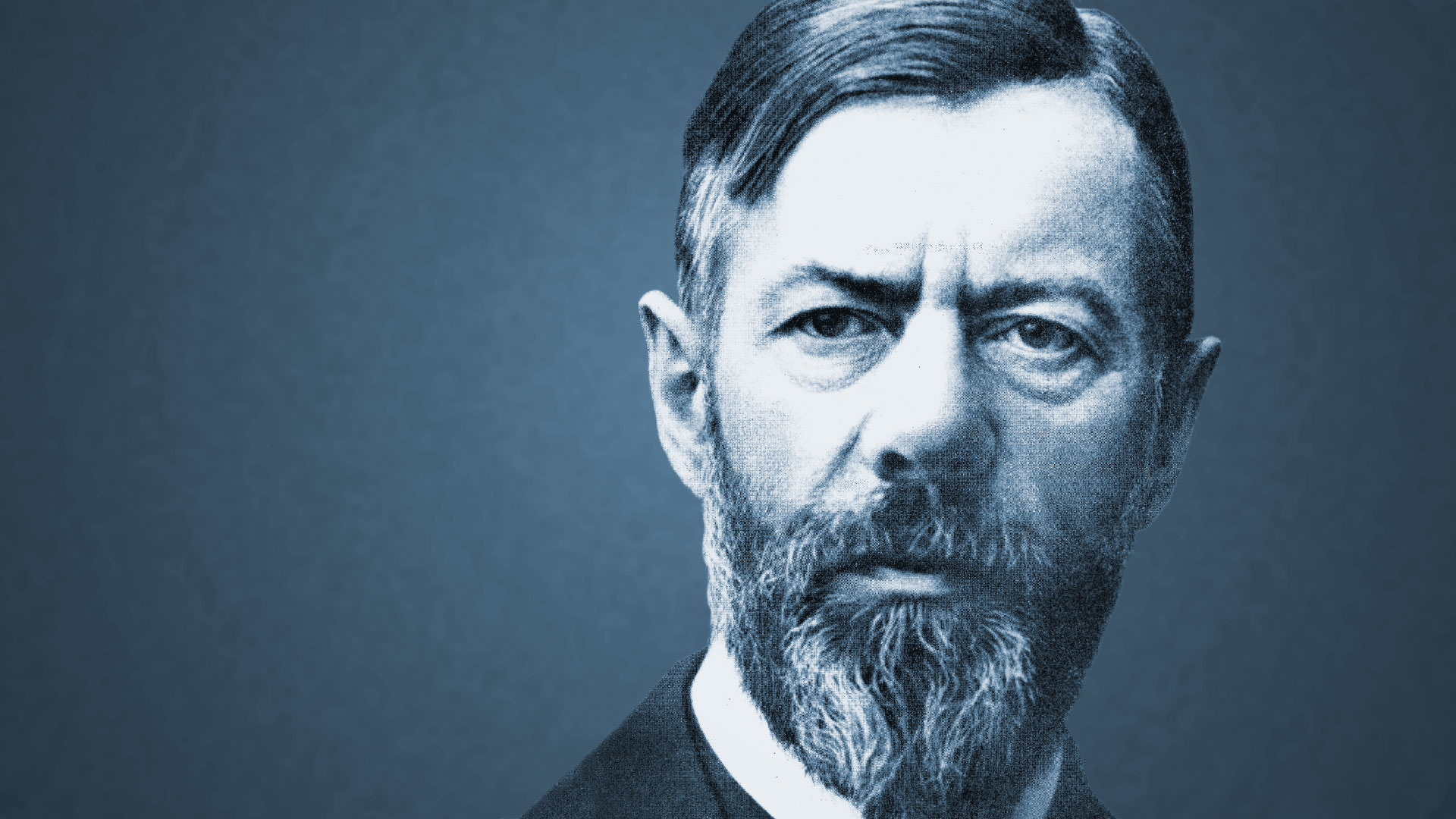
Max Weber, source: sociologicamente.it, access date: May 31, 2026.
1.
1. xi. 2. 7. 33.
2. x. 1. 5. 4.
3. iv. 6. 1. 1; xi. 1, 8. 6; xii. 8. 3. 31.
4. Weber quote in J.R.A.S., i. 1895, 306 ff.
5. Ibid.
6. Śat. Brāh., vi. 2. 2. 27. Kṛtaṁ lokaṁ puruṣo’bhiyāyate.
7. Śat. Brāh., xii. 9. 11.
8. Śat. Brāh., ii. 6.
1.
2.
135
“To men of the mild disposition and reflective spirit of the Indians, it would not appear that reward and punishment could be eternal. They would conceive that it must be possible by atonement and purification to become absolved from the punishment of the sins committed in this short life. And the same way, they could not imagine that the reward of virtues practiced during the same brief period could continue for ever.” When we finish experiencing our rewards and punishments, it is suggested that we die to that life and are reborn on earth. The natural rhythm by which life gives birth to death and death to life leads us to the conception of a beginning less and endless circuit.1 The true ideal becomes redemption from bondage of life and death or release from saṁsāra. “He who sacrifices to the gods does not gain so great a world as he who sacrifices to the Ātman.”2 “He who reads the Vedas is freed from dying again and attains to a sameness of nature with Brahman.”3 Death with birth for its cause seems to have become a thing to be avoided. Later, we find the conception that those who merely perform rites without knowledge are born again and repeatedly become the food of death.4 In another passage5 there is suggested the Upaniṣad conception of a higher state than that of desire and its fulfillment, the condition of true immortality. “This soul is the end of all this. It abides in the midst of all the waters; it is supplied with all objects of desire; it is freedom desire, and possesses all objects of desire, for it desires nothing.” “By knowledge men ascend to that condition in which desires have passed away. Thither gifts do not reach nor austere devotees who are destitute of knowledge does not attain that world by gifts or by rigorous abstention. It pertains only to those who have such knowledge.”6 The Brāhmaṇas contain all the suggestions necessary for the development of the doctrine of rebirth. They are, however, only suggestions,
---------------
1. See Aitareya Brāh., iii. 44.
2. xi. 2. 6.
3. x. 5. 6. 9.
4. Śat. Brāh., x. 4. 3. 10. See also x. 1. 4. 14; x. 2. 6. 19; x. 5. 1. 4; xi. 4. 3. 20.
5. x. 5. 4. 15.
6. Śaṁkara refers to this passage in his Commentary on the Vedānta Sūtras to show how near to his own view this position is.
1.
2.
136
while individual immortality is the main tendency. It is left for the Upaniṣads to systematize these suggestions into the doctrine of rebirth. While the conceptions of karma and rebirth are unquestionably the work of Aryan mind, it need not be denied that the suggestions may have come from the aborigines, who believed that after death their souls lived in animal bodies.
In spite of suggestions of a higher ethics and religion, it must be said that the age was, on the whole, one of Pharisaism, in which people were more anxious about the completion of their sacrifices than the perfection of their souls. There was need for restatement of the spiritual experience, the central meaning of which was obscured by a legalistic code and conventional piety. This the Upaniṣads undertake.
1.
2.
REFERENCES.
BLOOMFIELD: The Atharva-Veda, S.B.E., vol. xliii.
EGGELING: Śatapatha Brāhmaṇa, S.B.E., vol. xi, Introduction.
HOPKINS: The Religions of India, chap. ix.
1.
2.
3.
4.
5.