MENU
TH EN

Indian Philosophy Volume 1.007 - Transition to the Upaniṣads

Title Thumbnail & Hero Image: Bharat Dev, source: www.pinterest.com, access date: Sep.6, 2025.

Indian Philosophy Volume 1.007 - Transition to the Upaniṣads
1.
First revision: Sep.6, 2025
Last change: Mar.18, 2026
Searched, gathered, rearranged, translated, and compiled by
Apirak Kanchanakongkha.
1.
Page 117
1.
2.
CHAPTER III
1.
TRANSITION TO THE UPANIṢADS
 
The general character of the Atharva-Veda – Conflict of cultures – The primitive religion of the Atharva-Veda-Magic and mysticism – The Yajur-Veda – The Brāhmaṇas – Their religion of sacrifice and prayer – The dominance of the priest – The authoritativeness of the Veda – Cosmology – Ethics – Caste – Future life.  
 
 
 I
T
HE ATHARVA-VEDA
"THE hymns of the Ṛg-Veda inextricably confused; the deities of an earlier era confounded; and again merged together in a pantheon now complete; the introduction of strange gods; recognition of a hell of torture; instead of many divinities, the one that represents all the gods and nature as well; incantations for evil purposes and charms for a worthy purpose; formulæ of malediction to be directed against those 'whom I hate and who hate me'; magical verses to obtain children, to prolong life, to dispel evil magic, to guard against poison and other ills; the paralysing extreme of ritualistic reverence indicated by the exaltation to godhead of the 'remnant' of sacrifice; hymns to snakes, to diseases, to sleep, time, and the stars; curses on the 'priest plaguer' - such in general outline is the impression produced by a perusal of the Atharva-Veda."1 In the Ṛg-Veda we come across strange utterances of incantations and spells, charms and witchcrafts, hymns to inanimate things, devils and demons, etc. We have the charms of the robbers to lull the dwellers in a house to sleep,2  
---------------

1. Hopkins: The Religions of India, p.151.
2. R.V., vii., 55.

1.
2.

118
spells to prevent evil spirits causing women to miscarry,1 and charm to expel diseases.2 Though sorcery and magic prevailed in the times of the Ṛg-Veda, the Vedic seers did not encourage or recognise them. The stray references have the appearance of an external addition, while in the Atharva-Veda they are the main theme.

       The weird religion that the Atharva-Veda represents is doubtless older than that of the Ṛg-Veda, though the Atharva-Veda collection is a later one. The Vedic Aryans as they advanced into India came across uncivilised tribes, wild and barbarous, and worshipping snakes and serpents, stocks and serpents, stocks and stones. No Society can hope to continue in a state of progressive civilisation in the midst of uncivilised and half-civilised tribes, if it does not meet and overcome the new situation by either completely conquering them or imparting to them elements of its own culture. The alternatives before us are either to destroy the barbarian neighbours or absorb them, thus raising them to a higher level, or allow ourselves to be overwhelmed and swamped by them. The first course was impossible on account of the paucity of numbers. The pride of race and culture worked against the third. The second was the only alternative left open, and it was adopted. While the Ṛg-Veda describes the period of conflict between the fair-skinned Aryans and the dark Dasyus01, which Indian mythology makes into a strife of Devas and Rākṣasas, 
---------------

1. R.V., x. 122.
2. R.V., x. 163.

Notes & Narratives:

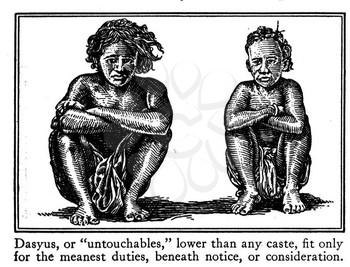
Dasyus, source: clipart.com, access date: Mar.18, 2026.
1.
01. Dasyus (दस्यु - ทัสยุ) - The ancient dwellers of North India. What we see in Ṛgveda is mostly a history of the Āryans from the period of their exodus from the plateau Kumbha till they reached the banks of the Yamunā. The plateau of Kuṃbha is Kabul. The Dasyus were the first people the Aryans had to confront with after passing the Indus. Ṛgveda bears testimony to the fact that the civilization of the Dasyus was far advanced than that of the Āryans. Śaṃbara, King of the Dasyus, was the ruler of hundred cities. All the cities were fortified with strong walls and fortresses, which are described as 'aśvamayī', 'āyasī', 'śatabhujī' etc. The greatest enemies of the Āryans were the 'Paṇis' of these cities. They were a particular class of people of these cities. In the 'Nirukta of Yāska' it is mentioned that paṇis were traders. Names of many of the Kings of the Dasyus occur in the Ṛgveda. Dhuni, Cumuri, Pipru, Varcas, Śaṃbara and such others are the most valiant and mighty among them. The most important of the several tribes of the Dasyus were the Śimyus, the Kīkaṭas, Śigrus and the Yakṣus. They are mentioned as the Anāsas in the Ṛgveda. (Anāsas—without nose). Perhaps their nose was flat; more over they are stated as having dark complexion. So it may be assumed that the Dasyus were Dravidians. They talked a primitive language, and they despised sacrificial religion. They did not worship Gods like Indra and others. They possibly worshipped the Phallus, Śiva, Devi and the like.


humanexcellence.thailand@gmail.com